

What Is D2 Tool Steel?

D2 tool steel is a high-carbon, high-chromium cold work tool steel known for strong wear resistance, good dimensional stability after heat treatment, and typical working hardness around 58-62 HRC. In international standards, it is commonly matched with AISI D2, DIN/EN 1.2379, JIS SKD11, and GB Cr12Mo1V1, although exact chemistry windows and delivery practices can vary by mill and specification.
This guide is written from a steelmaker’s perspective. Nantian is a tool and die steel manufacturer in Huangshi, Hubei, China, with 300,000 tons annual capacity, Austrian GFM radial forging, INTECO ESR systems, and exports to markets across Europe, the Americas, Southeast Asia, the Middle East, and South America. I’m writing this for engineers who need a clear, standard-based answer—not a vague sales pitch.
Contents [ hide ]
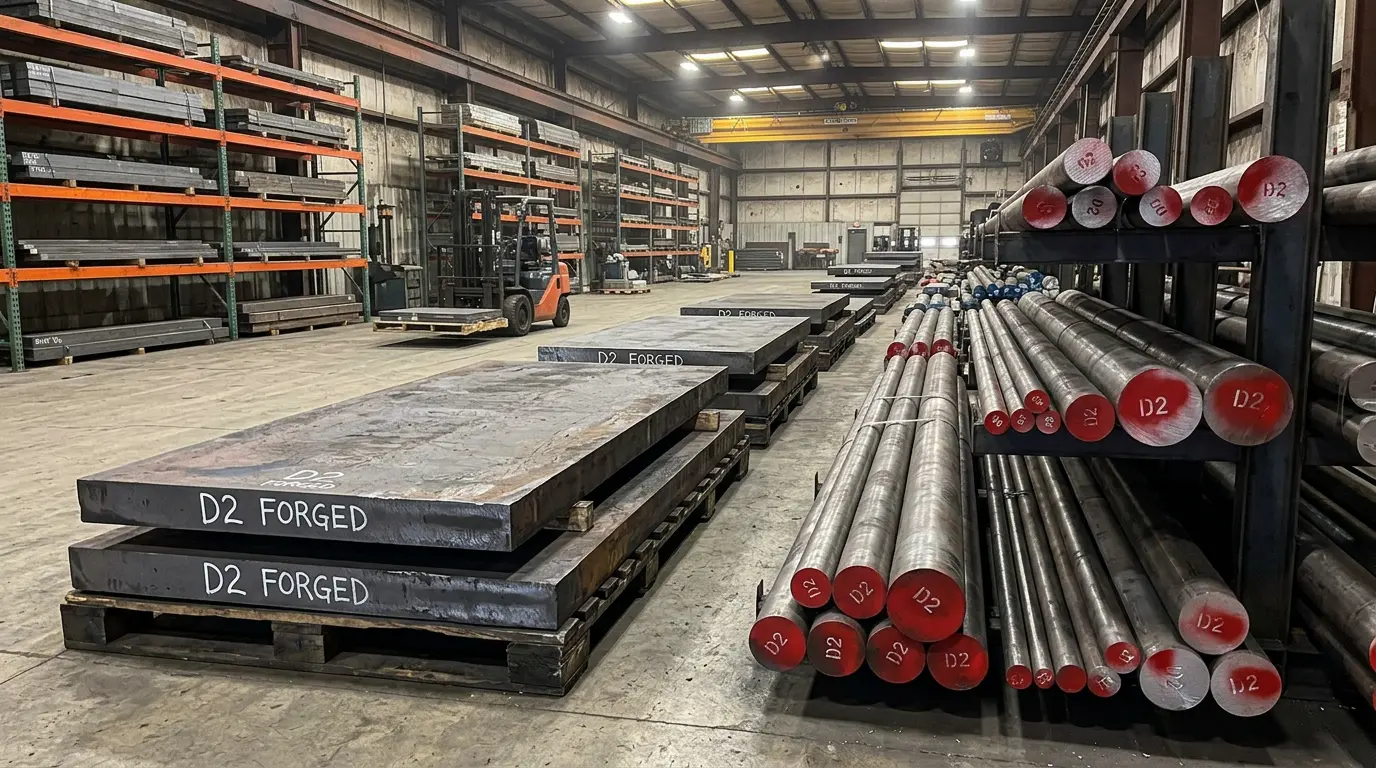
What D2 tool steel actually is
D2 is one of the most widely used cold work tool steels for punching, blanking, slitting, and wear-heavy tooling. Its reputation comes from one simple fact: it carries enough carbon and chromium to form a large volume of hard carbides, which slows wear in service.
How is D2 defined in plain engineering terms?
D2 is a high-carbon, high-chromium cold work tool steel. It is designed for applications where abrasive wear resistance matters more than impact toughness. Unlike lower-alloy grades such as O1, D2 keeps better edge retention and dimensional stability, but it is less forgiving under shock loads.
Cold work tool steel means a steel grade used for tooling that shapes or cuts material at relatively low temperatures, usually near room temperature. In die work, that includes blanking dies, forming dies, shear blades, thread rolling dies, and precision punches.
Wear resistance is the ability of steel to resist material loss during friction, sliding, or repeated contact. In D2, this comes largely from chromium-rich and vanadium-containing carbides distributed through the matrix after proper heat treatment.
Dimensional stability refers to how well the steel keeps its size and shape through hardening and tempering. D2 is often chosen for this reason in precision cold work tooling, where die opening drift or distortion can ruin finished part tolerances.
Which international grades are considered equivalent?
The common grade family is AISI D2 / DIN 1.2379 / JIS SKD11 / GB Cr12Mo1V1. Fair question: are they always identical? Not exactly. They are close equivalents for engineering selection, but chemistry tolerances, cleanliness levels, ESR options, and testing requirements may differ from one standard or supplier to another.
According to ASTM International, tool steel specifications in North America are typically referenced through ASTM A681 and related grade practices. Under the European system, 1.2379 is covered within the framework of EN ISO 4957. JIS uses SKD11 under JIS G4404.
🟢 PRACTICAL TAKE
If your drawing says “D2,” do not stop at the grade name. Ask for the exact standard reference, chemistry range, delivery condition, hardness range, and ultrasonic testing level. I’ve seen buyers approve “equivalent D2” on paper, then receive steel that machines differently because carbide distribution and annealing practice were not aligned.
AISI D2 composition and standard cross-reference
The chemistry is the real reason D2 behaves the way it does. High carbon drives hardness and carbide volume; high chromium supports wear resistance and hardenability; molybdenum and vanadium refine performance.
What is the typical AISI D2 composition?
AISI D2 composition is typically around 1.40-1.60% carbon, 11.0-13.0% chromium, 0.70-1.20% molybdenum, and 0.70-1.20% vanadium, with manganese and silicon usually kept at lower supporting levels. Exact limits depend on the governing standard and mill practice.
Carbide segregation is the uneven concentration of carbides in certain areas of the steel. It matters because severe segregation can create local brittleness, unstable machining behavior, and early cracking in service. In our melt shop, we’ve seen firsthand that refining route and forging reduction ratio can change real-world consistency more than buyers expect from a simple chemistry sheet.
| Grade System | Common Grade | Type | Typical Notes |
|---|---|---|---|
| ASTM / AISI | D2 | Cold work tool steel | High wear resistance, air-hardening grade |
| DIN / EN ISO | 1.2379 | Cold work tool steel | European designation widely used in mold shops |
| JIS | SKD11 | Alloy tool steel | Common in Japan and Asia supply chains |
| GB | Cr12Mo1V1 | Cold work die steel | Chinese equivalent used for export and domestic tooling |
The table gives a practical cross-reference, not a legal substitution statement. If your project is tied to PPAP, end-customer approvals, or regulated documentation, match the purchase order to the exact standard edition and required test reports.
How do ASTM, DIN/EN, JIS, and GB line up?
They line up closely enough for most engineering discussions, but not perfectly enough to ignore paperwork. According to EN ISO 4957 and ASTM A681 practice, grade designation, chemistry tolerance, and delivery condition must be read together—not as separate items.
According to ISO, tool steels are grouped by application and chemical family rather than trade names alone. According to ASTM A681, the buyer should specify grade, product shape, condition, and any supplementary requirements. According to JIS G4404, alloy tool steel designations such as SKD11 are tied to prescribed chemistry and processing requirements. Data from major European distributors in 2025 also shows that 1.2379 remains one of the most quoted cold work grades for wear-dominant die applications.
If you are comparing suppliers, ask to see the MTC, hardness report, and if needed, SEP1921 ultrasonic testing records.
D2 steel properties that matter in die work
D2 steel properties look excellent on a spec sheet, but not every property carries the same weight in production. For cold stamping dies, the big three are wear resistance, compressive strength, and heat-treatment stability.
Why is D2 so wear resistant?
The short answer is carbide content. D2 contains enough carbon and chromium to form a large amount of hard chromium-rich carbides, with vanadium contributing additional wear-resistant particles.
According to metallurgical data widely cited in tool steel handbooks, D2 typically offers higher wear resistance than O1 and A2, but lower toughness than A2. That tradeoff is why D2 is common in long-run blanking tools, shear knives, and slitter components where edge life matters more than impact absorption.
Air-hardening means a steel can harden during cooling in still air or controlled gas rather than requiring an aggressive liquid quench. That lowers quench distortion compared with water-hardening grades. Big difference for precision dies.
Where does D2 have limits?
D2 is not the answer for every die. I don’t recommend it for high-impact cold work applications where chipping or sudden fracture is the main failure mode. In those jobs, A2, S7, or upgraded modified grades may be safer choices.
Honestly, I think too many steel traders oversimplify this grade. They describe D2 as if “high wear resistance” means “best overall.” It doesn’t. A mold maker in Stuttgart once told me his team switched away from standard D2 in a shock-loaded forming station because edge life was good, but corner chipping was still costing them downtime.
💡 PRO TIP
If your die failure history shows edge rounding and abrasive wear, D2 is usually a strong candidate. If your failure history shows impact chipping, cracked punch corners, or shock loading, pause before defaulting to D2. Grade selection should follow the failure mode, not habit.
D2 steel hardness and heat treatment range
D2 steel hardness after heat treatment usually falls around 58-62 HRC for most cold work die applications. Some applications push higher, but that is where toughness penalties start to show.
What hardness can D2 steel reach?
For practical shop use, 60 HRC is a common target. Depending on section size, austenitizing temperature, tempering schedule, and service goal, D2 can often be used in the 58-62 HRC range. Some data sheets list peak hardness around 64 HRC, but production tools are rarely run at the absolute maximum because brittleness rises.
According to common mill data and heat treatment references, annealed D2 is often delivered at roughly ≤255 HB for machining, then hardened after rough or semi-finish machining. At Nantian, our standard annealed black surface plus sandblasting delivery condition is built for this stage of the process, with QR-code traceability on each plate head.
What heat treatment window is commonly used?
Typical hardening practice for D2 often falls around 980-1040°C austenitizing, followed by air or gas cooling and multiple tempers, but exact schedules vary by section size and end use. Secondary hardening behavior can appear depending on the tempering temperature used.
That said—heat treatment is where equivalent grades start to separate in real life. Two suppliers can both sell “D2,” yet one batch shows cleaner response after tempering because the steel had better carbide uniformity and lower segregation from the start. During forged-tool-steel production, forging reduction, spheroidizing anneal control, and decarburization management all leave fingerprints on downstream performance.
| Property | Typical D2 Range | Why It Matters |
|---|---|---|
| Annealed hardness | Around 220-255 HB | Machinability before hardening |
| Working hardness | 58-62 HRC | Balance of wear life and fracture risk |
| Hardening temperature | About 980-1040°C | Controls dissolved carbides and final hardness |
| Delivery condition | Annealed, black skin or machined | Affects machining prep and stock allowance |
Use these as engineering ranges, not one-size-fits-all heat treatment instructions. Your furnace type, section thickness, retained austenite target, and final die geometry all matter.
Suggested image 3: Heat-treated D2 hardness test
Alt text: D2 steel hardness testing after tempering
File name: d2-steel-hardness-testing.jpg
Caption: Final hardness should be verified with a multi-point test, not a single reading.
Best uses, quality checks, and buying notes
D2 works best where wear is the enemy and impact is moderate. If you are sourcing globally, quality verification matters almost as much as the grade itself.
What tool steel jobs is D2 best for?
D2 is commonly used for:
Blanking dies
Cold stamping dies
Shear blades and slitter knives
Thread rolling dies
Forming rolls
Punches with controlled shock levels
According to market data published by Grand View Research in 2025, growth in industrial tooling demand continued to be driven by automotive, electronics, and precision manufacturing. That trend supports continued demand for wear-resistant cold work grades like D2 and 1.2379.
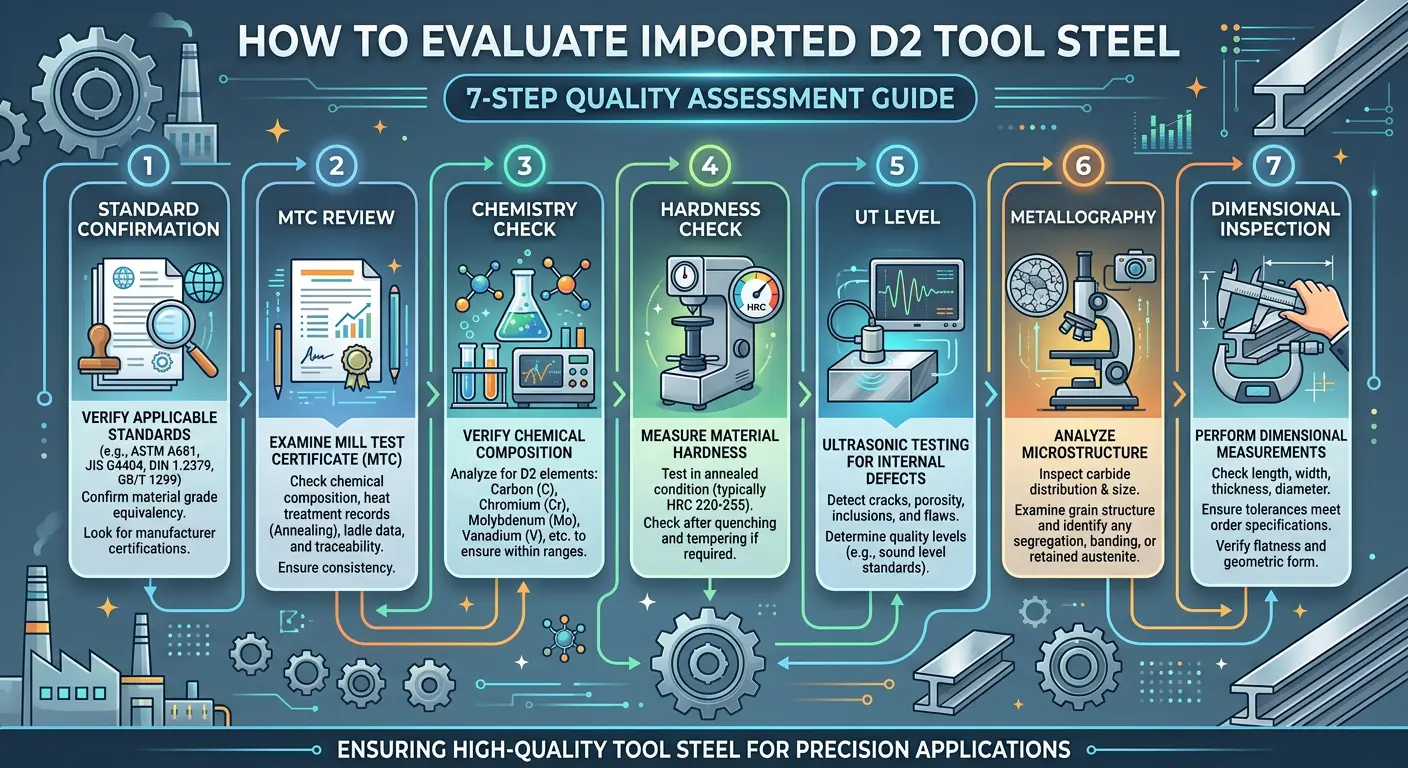
How should you verify imported D2 steel?
One thing I always recommend to first-time steel importers: verify the steel as a system, not as a grade name.
Check the exact standard: AISI D2, DIN 1.2379, JIS SKD11, or GB Cr12Mo1V1
Request the MTC with heat number traceability
Confirm annealed hardness range before machining
Ask whether the bar or plate is forged, rolled, ESR, or conventional melt
Review ultrasonic testing level, especially for thick sections
Verify decarburization control and metallography if die life is critical
Confirm dimensional tolerance and straightness or flatness report
At Nantian, we typically support this with chemical analysis, hardness testing, metallography, dimensional checks, and ultrasonic testing according to SEP1921. For buyers working on non-standard sections, ask us about custom-size D2 plates and bars .
⚙️ INSIDER NOTE
Not every D2 order needs ESR. For general cold work tooling, well-made conventional melted and properly forged D2 is often enough. But if you are buying thick sections, high-value dies, or parts sensitive to internal defects, ESR can reduce segregation and improve structural uniformity. It costs more, so use it where it earns its keep.
Key takeaways for engineers and buyers
What is D2 tool steel? It is a high-carbon, high-chromium cold work tool steel built for wear-heavy tooling, commonly sold under AISI D2, DIN 1.2379, JIS SKD11, and GB Cr12Mo1V1. If your application is cold stamping, blanking, or slitting, D2 remains one of the most practical grades in 2026—provided the steel is made and tested correctly.
D2 steel properties are centered on wear resistance, compressive strength, and dimensional stability.
AISI D2 composition typically includes about 1.40-1.60% C and 11.0-13.0% Cr, with Mo and V for performance balance.
D2 steel hardness in service is commonly 58-62 HRC after proper heat treatment.
Equivalent grades exist across ASTM, DIN/EN, JIS, and GB systems, but delivery condition and cleanliness still matter.
For imported steel, MTCs, UT reports, and metallography are not paperwork extras. They are risk control.
If you need D2/1.2379 plate or round bar with traceable heat numbers, standard or custom sizes, and factory-side testing support, we can help. You can browse our cold work steel grades → or ask for a quote with your required standard and dimensions.
Frequently Asked Questions
What is D2 tool steel used for?
D2 tool steel is mainly used for cold work tooling such as blanking dies, punches, shear blades, slitter knives, and forming tools. It is chosen when wear resistance and dimensional stability matter more than high impact toughness.
What is the difference between D2 and 1.2379?
D2 and 1.2379 are generally treated as equivalent cold work tool steel grades. The main difference is the standard system: D2 is the AISI/ASTM designation, while 1.2379 is the DIN/EN material number. Chemistry and mill practice can still vary slightly.
What is the typical AISI D2 composition?
Typical AISI D2 composition is about 1.40-1.60% carbon, 11.0-13.0% chromium, 0.70-1.20% molybdenum, and 0.70-1.20% vanadium. Exact ranges depend on the applicable standard and the supplier’s certified chemistry report.
What hardness can D2 steel reach after heat treatment?
D2 steel commonly works in the 58-62 HRC range after proper hardening and tempering. Some heat treatment schedules can push hardness higher, but many die shops avoid the maximum because fracture risk increases.
Is D2 tool steel stainless?
No, D2 is not considered stainless steel. It contains high chromium, but much of that chromium is tied up in carbides, so its corrosion resistance is much lower than true stainless grades.
Which is better for cold stamping dies, D2 or A2?
For abrasive wear and long runs, D2 is often better. For higher toughness and better resistance to chipping under shock, A2 may be the safer choice. The better grade depends on the die failure mode, not the catalog ranking.
How do I verify the quality of D2 steel imported from China?
Start with the MTC and heat number, then check chemistry, annealed hardness, size tolerance, ultrasonic testing, and if needed, metallography. For thick or high-value die steel, ask whether the material is ESR or conventional melt.
Where can I buy D2 tool steel directly from a Chinese manufacturer?
You can buy D2 tool steel directly from integrated Chinese mills that produce, forge, roll, inspect, and export the grade with full traceability. For factory-direct supply, ask for production capability, test reports, standard compliance, and custom-size support before ordering.
References & Sources
ASTM Tool Steel Standards Portal — ASTM International (2025)
ISO 4957: Tool steels — International Organization for Standardization (latest available reference)
JIS Standards Committee Portal — Japanese Industrial Standards Committee (2025)
World Steel Association Data & Publications — World Steel Association (2025)
Tool Steel Market Research Coverage — Grand View Research (2025)
Industrial Inspection and Testing Resources — SGS (2025)
Need D2 Tool Steel for Your Die Project?
Factory-direct pricing. Full MTC traceability. Custom sizes and test reports available.
Export Manager at HUBEI NANTIAN TOOL AND MOLD TECHNOLOGY CO.,LTD. — Nantian is a China-based tool and mold steel manufacturer with integrated melting, forging, rolling, and export experience across Europe, the Americas, Southeast Asia, and the Middle East.
hbntkj@nantiansteel.com