

By Ajiao Liu | Nantian Steel Export Team | Updated June 2026
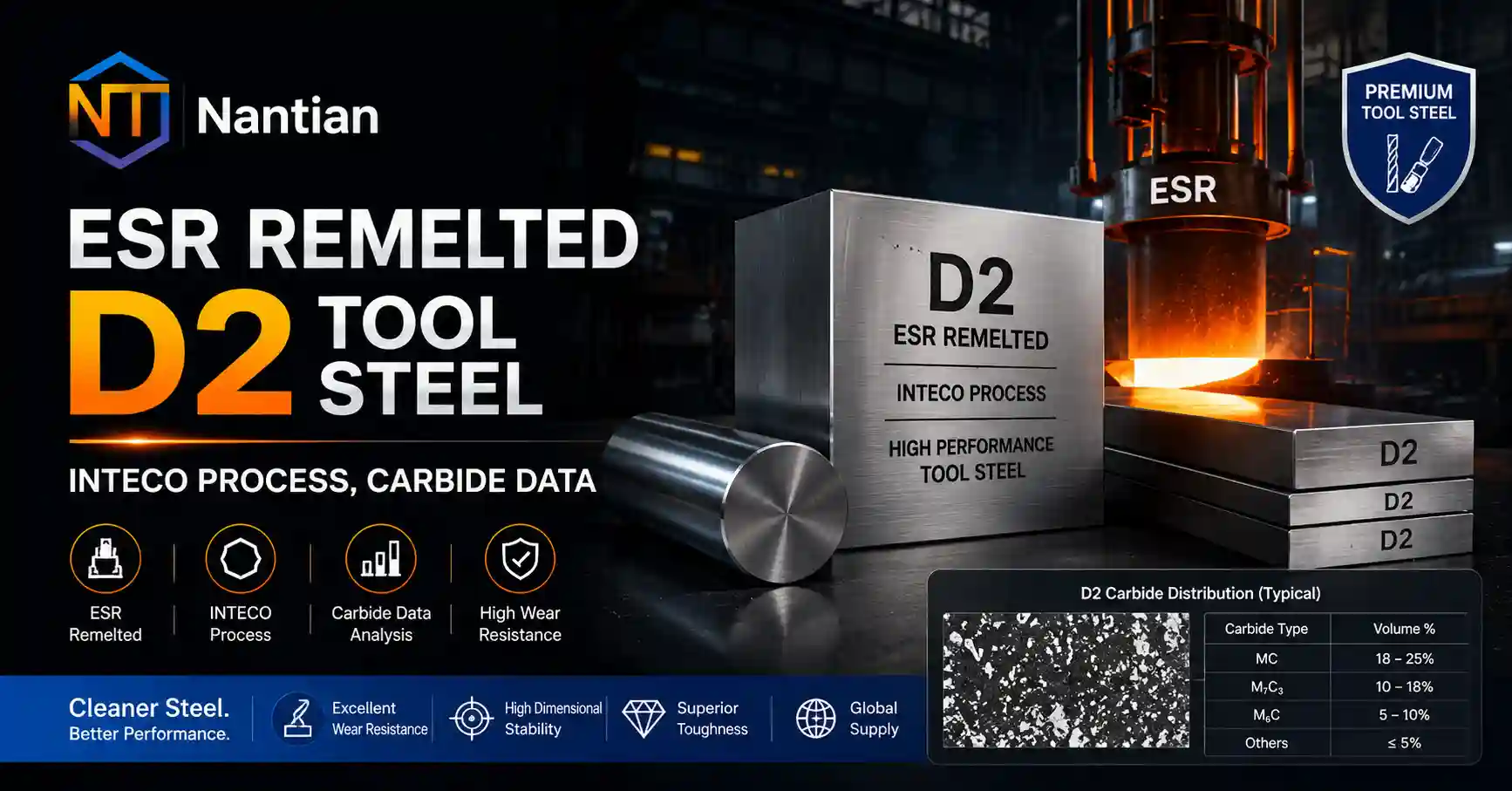
A D2 die that cracks at 80,000 cycles when the specification said 200,000 is not always a heat treatment problem. It's often a steel problem — and specifically, a carbide distribution problem that won't appear on the chemistry certificate. The MTC shows carbon at 1.52%, chromium at 11.8%, and everything within specification. The metallographic section tells a different story: angular Cr₇C₃ carbide clusters at 12–15µm sitting at prior dendritic boundaries, stress concentration factors of 3–4× at those interfaces, and a fatigue crack that propagated along a banded carbide layer, which the QC certificate never measured.
That failure mode is specific to conventionally produced D2 in large sections. It is not a property of the grade. It is a property of the production route. Electroslag remelting — ESR — eliminates it by controlling the solidification process at the ingot level, before forging, before rolling, before any downstream processing can either correct or conceal the as-cast defect structure.
This article covers the metallurgical mechanism of ESR in D2 production, the specific improvements delivered by atmosphere-protected INTECO remelting, the measurable differences versus conventional arc-melt D2, and the quality documentation that lets a QC manager verify those differences from incoming inspection rather than discovering them through die failure.
Written by the export team at Nantian (Hubei Nantian Tool and Mold Technology Co., Ltd.), Huangshi, Hubei, China. We operate an Austrian INTECO atmosphere- protection ESR system — 8-ton and 16-ton furnaces — and produce ESR-grade D2 / 1.2379 for precision die applications in Europe, the Middle East, and Asia. The process data in this article reflects our own production measurements, not published literature estimates.
Table of Contents
Why Conventionally Produced D2 Fails in Precision Die Applications
The ESR Mechanism: What Happens at the Solidification Interface
Nantian's INTECO ESR System: Equipment Specification and Process Control
Measured Improvements: ESR D2 vs Conventional D2 — Production Data
Inspection Protocol and Documentation: How QC Managers Verify ESR Quality
Application Guidance: Which D2 Applications Justify ESR Specification
Why Conventionally Produced D2 Fails in Precision Die Applications
D2's high carbon (1.40–1.60%) and chromium (11.0–13.0%) content make it the dominant wear-resistant cold work grade globally — and the same chemistry that creates its wear resistance also makes it the most microstructure-sensitive grade in routine cold work production. Understanding that sensitivity is the starting point for understanding why ESR exists as a production route.
During solidification of a conventionally arc-melted D2 ingot, carbon and chromium concentrate in the liquid phase ahead of the advancing solidification front. This solute segregation produces locally carbon-rich and chromium-rich regions at prior dendritic boundaries — where large, angular primary carbides form during cooling. These Cr₇C₃ carbides can reach 8–18µm in diameter in conventional production and cluster along the dendritic network rather than distributing uniformly through the matrix.
How Does Carbide Banding Translate to Die Failure in Practice?
The failure path is consistent across applications. Under cyclic compressive and tensile loading, the carbide-matrix interface becomes the preferred crack initiation site — particularly at angular carbide morphologies where stress concentration factors of 3–4× the nominal applied stress develop at carbide corners. Once initiated, fatigue microcracks propagate preferentially along banded carbide layers because the interlamellar matrix between carbide bands has locally depleted toughness from decarburization and residual casting stress.
The result is a die that fractures along a plane parallel to the banding, which in a rolled plate is parallel to the rolling direction, typically the die's working face. The fracture surface looks brittle, appears suddenly, and the chemistry certificate shows nothing wrong. In our production records, we classify this failure mode as "carbide-initiated fatigue fracture," — and it accounts for the majority of D2 die failures our customers have shared with us from previous conventionally sourced material.
Why Doesn't Forging Alone Solve the Carbide Banding Problem?
Short answer: it helps, but it doesn't fully resolve severe as-cast segregation in large sections. Forging reduction breaks up and redistributes carbide clusters to a degree — our 3,000-ton precision forging press applies reduction ratios that exceed standard minimums for this grade, and the improvement over rolling-only production is measurable. But the primary carbide size in a conventionally cast D2 ingot starts at 8–18µm before forging, and even optimal forging reduction cannot fully dissolve or fragment carbides that large. The thermodynamic limit is the solidification structure of the original ingot.
ESR addresses the problem at its source — before the ingot structure is fixed.
The ESR Mechanism: What Happens at the Solidification Interface
Electroslag remelting (ESR) is a secondary refining process that controls solidification by remelting a consumable electrode through a molten reactive slag — producing an ingot with fundamentally different as-cast microstructure compared to conventional arc melting, achieved through three simultaneous mechanisms.
Mechanism 1 — Inclusion Removal Through Slag Reaction
As the D2 electrode melts, liquid metal droplets fall through the molten slag layer before collecting in the liquid metal pool below. This droplet passage through slag is the primary refining event. Oxide inclusions (Al₂O₃, SiO₂) and sulfide inclusions (MnS) are chemically reduced and absorbed into the slag phase by reaction with the slag's active oxide components. The partition coefficient for sulfur between slag and metal in a properly controlled ESR system is typically 10–20, meaning sulfur preferentially concentrates in the slag at ratios of 10 to 20 times the metal concentration.
Result: non-metallic inclusion content in the ESR D2 ingot is reduced by 40–60% compared to the original arc-melt electrode material, measured per ASTM E45 rating methodology on metallographic sections.
Mechanism 2 — Controlled Solidification Rate and Thermal Gradient
In conventional arc melting, the ingot solidifies in a single large casting event — large thermal gradients, rapid solidification at the mold wall, slow solidification at the center, maximum segregation. In ESR, the liquid metal pool is small (typically 10–20% of the final ingot volume) and solidifies progressively from bottom to top as the electrode is consumed. The water-cooled copper mold provides a consistent radial cooling rate throughout the entire solidification sequence.
The controlled thermal gradient produces:
Finer primary carbide size — faster, more uniform solidification reduces the time available for carbide coarsening; primary carbide diameter in ESR D2 measures 3–8µm versus 8–18µm in conventional production
Reduced segregation band width — the progressive solidification front reduces solute accumulation ahead of the interface; carbide distribution uniformity across the ingot cross-section improves dramatically
Eliminated centerline porosity — conventional ingots develop shrinkage porosity at the center during the final solidification stage; ESR's progressive solidification eliminates this defect class
Mechanism 3 — Gas Content Reduction
The slag cover and controlled atmosphere in atmosphere-protected ESR prevent atmospheric nitrogen and hydrogen pickup during remelting. Hydrogen in tool steel — even at levels of 3–4 ppm — causes hydrogen-induced delayed cracking in large sections after heat treatment. Our INTECO atmosphere-protection system achieves dissolved hydrogen content of ≤ 2 ppm in the finished ESR ingot, and dissolved oxygen ≤ 15 ppm. These levels are comparable to vacuum arc remelted (VAR) grades at significantly lower process cost.
For QC managers: these gas content values are measurable and should appear on the MTC for ESR-grade D2. If a supplier claiming ESR production cannot report H₂ and O₂ values from the finished ingot, the ESR process control is not traceable.
Why Atmosphere Protection Matters for High-Chromium Grades
Atmosphere protection during ESR is not a universal requirement — it is specifically critical for high-chromium steels like D2/1.2379, where chromium oxidation at the ingot periphery during conventional open-air remelting creates a measurable surface chemistry gradient that propagates into the finished product.
In conventional (non-atmosphere-protected) ESR, the remelting environment is open to air. At operating temperatures of 1,500–1,600°C, chromium oxidizes preferentially at the slag-metal interface and at the ingot surface exposed to the furnace atmosphere. For stainless and low-alloy grades, this effect is manageable. For D2 at 11–13% Cr, the surface oxidation is sufficient to create a chromium-depleted zone in the outer 2–5mm of the finished ingot — detectable by surface spectrometer reading but easily missed on a center-cut sample.
What Does a Chromium-Depleted Surface Zone Actually Cause in a Die?
Three failure mechanisms, depending on die geometry:
Reduced hardenability at the working surface. Chromium is a primary hardenability element in D2. A 0.5–1.0% Cr depletion in the outer zone reduces as-hardened HRC by 1–2 points at the surface — exactly where wear resistance is most critical. This shows as a soft skin on cross-section hardness mapping, often attributed incorrectly to decarburization.
Inconsistent corrosion resistance at die edges. For precision blanking dies where surface staining or edge pitting during storage indicates corrosion resistance below specification, the Cr-depleted zone is a contributing factor. Mild in absolute terms for D2 (which is not stainless), but detectable in accelerated corrosion testing.
Surface chemistry mismatch with MTC data. If the MTC chemistry is measured from a center-cut sample (standard practice for conventional ESR), the reported Cr value will be higher than the actual Cr at the working surface of the finished plate or bar. For QC managers running incoming chemistry verification with a surface OES reading — which is the most common method — the result will not match the MTC, creating documentation discrepancies that are time-consuming to resolve.
Nantian's INTECO atmosphere-protection system runs an inert gas envelope (argon-based) over the remelting zone throughout the entire ESR cycle. Chromium oxidation at the slag-metal interface and ingot surface is eliminated. The finished ingot has a flat chromium profile from surface to center — verifiable by taking OES readings at multiple radial positions on an ingot cross-section.
Nantian's INTECO ESR System: Equipment Specification and Process Control
INTECO Special Melting Technologies GmbH is an Austrian engineering company based in Bruck an der Mur, Austria — a specialist manufacturer of ESR, VAR, and induction skull melting systems for the global tool steel and superalloy industries. Their ESR systems are installed at premium steel producers in Austria, Germany, Sweden, and other European facilities. Nantian's decision to import INTECO systems rather than sourcing domestically produced alternatives was driven by the control system architecture, slag composition database, and atmosphere-protection engineering. [外链建议:INTECO Special Melting Technologies → inteco.at — nofollow noopener]
Furnace Specifications
| Parameter | INTECO ESR Unit 1 | INTECO ESR Unit 2 |
|---|---|---|
| Furnace capacity | 8 tons | 16 tons |
| Ingot diameter range | φ250mm – φ620mm | φ500mm – φ1042mm |
| Atmosphere protection | Yes — inert gas envelope, full cycle | Yes — inert gas envelope, full cycle |
| Process control | One-click automated melting — voltage, current, melt rate controlled by INTECO PLC system | One-click automated melting — voltage, current, melt rate controlled by INTECO PLC system |
| Slag composition control | Computerized slag chemistry management per grade specification | Computerized slag chemistry management per grade specification |
| Melt rate control | Closed-loop weight-based control | Closed-loop weight-based control |
| Electrode preparation | Cast electrode from EAF/LF/VD melt, matched composition to finished grade | Cast electrode from EAF/LF/VD melt, matched composition to finished grade |
What Does "One-Click Automated Melting" Mean for Quality Reproducibility?
In manually controlled ESR, the melt rate — and therefore the solidification rate and thermal gradient in the ingot — depends on operator adjustments throughout the remelting cycle. Variation in melt rate translates directly to variation in carbide distribution uniformity within the ingot. Faster local melt rates produce finer carbides; slower sections produce coarser ones. In a 16-ton ingot requiring 8–12 hours of remelting, manual control introduces systematic variation that is difficult to eliminate.
INTECO's automated PLC control system maintains a preset melt rate profile throughout the entire cycle — adjusting voltage and current in real time to hold the target melt rate within ±2% of specification. The same thermal gradient, the same solidification rate, from the first millimeter of ingot to the last. That process consistency is what produces reproducible carbide distribution from heat to heat — and it's the basis for our heat-to-heat quality guarantee on repeat orders.
GFM Radial Forging After ESR: Completing the Microstructure
ESR produces a cleaner, more uniform as-cast ingot — but the ingot still requires mechanical working to achieve the final grain structure, carbide morphology, and dimensional form required for tool steel applications. The combination of ESR plus properly controlled forging is what delivers production-grade ESR D2 that outperforms both ESR-only (unworked ingot) and forged-only (conventionally cast) material.
At Nantian, ESR ingots for D2 round bar production proceed to our Austrian-imported GFM SXL-40 mechanical radial forging machine before any rolling step.
GFM System Specifications
Equipment: Austrian GFM SXL-40 mechanical radial forging machine
Forging frequency: 270–500 strokes per minute (adjustable to grade and section)
Dimensional accuracy: 0–1mm tolerance on finished diameter
Output range: φ70–250mm diameter round bars, forging length up to 8.5m
Input: ESR ingot or conventionally cast ingot (different production sequences)
What Does Radial Forging Do to ESR D2 Microstructure?
Conventional single-die forging applies reduction in one direction per stroke — producing asymmetric grain flow and requiring multiple rotations to achieve circumferentially uniform reduction. Radial forging uses four hammers positioned at 90° intervals around the workpiece, applying simultaneous reduction from four directions per stroke. The result:
Uniform grain flow in all radial directions — the four-hammer arrangement produces a symmetrical forging pattern around the bar axis, which means the carbide distribution improvement from ESR is preserved uniformly through the bar cross-section rather than being disrupted by asymmetric forging
Higher forging reduction ratio at equivalent pass count — the simultaneous four-direction reduction is more efficient at breaking up any residual carbide clusters from the ESR ingot than sequential single-direction forging
0–1mm dimensional accuracy on final diameter — the automated stroke frequency and closed-loop dimensional feedback of the GFM system produces consistently round bars without the oval cross-section that can result from manual hammer forging
The combination of INTECO ESR (clean ingot, fine carbides, uniform distribution) followed by GFM radial forging (symmetrical mechanical working, high reduction ratio, dimensional precision) is what produces the final microstructure we characterize in the next section. Neither step alone is sufficient. The sequence matters.
Measured Improvements: ESR D2 vs Conventional D2 — Production Data
The following data is drawn from Nantian's internal production records — metallographic sections, spectrometer readings, hardness maps, and gas content measurements taken during routine QC on ESR versus conventional D2 production heats of equivalent chemistry (C 1.50–1.55%, Cr 11.8–12.2%, Mo 0.90–1.05%, V 0.80–0.95%). Section sizes compared: 80mm diameter round bar and 120mm thick plate.
| Quality Parameter | Measurement Method | Conventional D2 (EAF/LF/VD route) | ESR D2 (INTECO atmosphere- protected) | Improvement |
|---|---|---|---|---|
| Primary carbide diameter | Metallographic section, SEM imaging, mean of 50+ measurements | 8–18 µm (mean ~12 µm) | 3–8 µm (mean ~5 µm) | Mean carbide size reduced ~58%; maximum carbide diameter reduced ~56% |
| Carbide distribution uniformity | Eutectic carbide level per ASTM E45 analogous rating; band width measurement | Moderate banding in sections >80mm; band width 50–150µm | Uniform distribution; band width <20µm or absent | Carbide banding effectively eliminated in sections up to 200mm |
| Non-metallic inclusion rating | ASTM E45 Method A — thin series (A, B, C, D) at 100× magnification | Sulfide (Type A): 1.5–2.5 Oxide (Type B/C): 1.0–2.0 Silicate (Type D): 0.5–1.5 | Sulfide (Type A): 0.5–1.0 Oxide (Type B/C): 0.5–1.0 Silicate (Type D): 0.5–1.0 | 40–60% reduction across all inclusion types |
| Dissolved hydrogen (H₂) | Inert gas fusion analysis (carrier gas hot extraction) | 2–5 ppm | ≤ 2 ppm | Below hydrogen-induced cracking threshold (<2 ppm) — consistently |
| Dissolved oxygen (O₂) | Inert gas fusion analysis | 20–40 ppm | ≤ 15 ppm | ~50% reduction; comparable to VAR-grade cleanliness |
| Cross-section hardness uniformity | Leeb hardness mapping — 9 points per cross-section (center + mid-radius + surface × 3 orientations) | ±3–4 HRC variation
(80mm section after HT) ±4–6 HRC variation (120mm+ section after HT) | ≤ ±1.5 HRC variation
(sections up to 150mm) ≤ ±2.0 HRC variation (sections 150–360mm) | Hardness uniformity improved 2–3× across all section sizes |
| Surface Cr% uniformity | OES spectrometer at surface (2mm depth) vs center core | N/A — conventional, no ESR | Surface-to-center Cr% delta <0.2% (within OES measurement uncertainty) | Atmosphere protection eliminates Cr-depleted surface zone |
| Decarburization layer depth | Metallographic section, microhardness traverse | 0.3–0.8 mm | 0.2–0.5 mm | Reduced decarb depth from nitrogen annealing atmosphere control |
One point on reading this data honestly: the cross-section hardness uniformity figures for sections above 150mm show ≤ ±2.0 HRC for our ESR D2 — better than conventional (±4–6 HRC at that section size), but not as tight as sections under 150mm. Large-section heavy die blocks above 200mm thickness are where Böhler's decades of forging reduction optimization still provide a marginal advantage over our production. We report what we measure, not what would be convenient to claim.
Inspection Protocol and Documentation: How QC Managers Verify ESR Quality
The data in Section 6 is only commercially useful if a QC manager can verify it independently on incoming material — either through supplier-provided documentation that is traceable to specific measurements, or through incoming inspection capable of confirming the key parameters. Both routes are available for Nantian ESR D2.
What Nantian's ESR 1.2379 Documentation Package Contains
Standard documentation for every ESR D2 order:
EN 10204 Type 3.1 MTC — full elemental analysis (C, Cr, Mo, V, Si, Mn, P, S) with actual measured values; hardness readings at minimum 5 points per piece with individual values reported; UT result per SEP1921 standard with acceptance class specified; decarburization layer depth from metallographic section; delivery condition (annealed + sandblasted, ≤ 255 HB)
ESR process identification — ESR heat number linking to the specific INTECO remelting run; furnace size (8t or 16t); ingot diameter; electrode heat number (tracing back to the original EAF/LF/VD melt chemistry)
Metallographic inspection report — per-batch section showing carbide distribution evaluation (eutectic carbide level), ASTM E45 inclusion rating (individual type scores), grain size per ASTM E112, and decarburization depth measurement. Available as standard for ESR orders — not an additional cost item.
Gas content certificate — H₂ and O₂ values from inert gas fusion analysis on the ESR ingot. This certificate is produced as standard for ESR-grade orders; it is not available for conventionally produced D2 because we don't run gas analysis as standard on non-ESR heats.
QR code on every plate head/bar end — scannable link to the complete digital inspection record for that specific piece: heat number, ESR run identification, chemistry, hardness point map, UT result, metallographic batch reference, production date.
Incoming Inspection Protocol for QC Verification of ESR Claims
For a QC manager qualifying Nantian ESR D2 for the first time, the following incoming inspection sequence verifies the key ESR quality parameters within a standard laboratory setup:
Chemistry verification (OES surface reading): Compare against MTC values. Surface-to-MTC delta on Cr should be < 0.2% for atmosphere-protected ESR. A larger surface Cr deficit indicates either conventional ESR (no atmosphere protection) or a Cr-depleted surface not disclosed on the MTC.
Hardness mapping (cross-section or surface multi-point): Verify ≤ ±1.5 HRC variation for sections ≤ 150mm against the individual hardness readings on the MTC. If the supplier's MTC shows only a single average value without individual readings — that's not a Type 3.1 certificate; it's a works certificate.
Metallographic section (first order, one piece per heat): Cut and etch a 20mm cross-section at mid-length. Evaluate at 100× and 200× magnification:
Carbide size — compare to 3–8µm ESR specification
Carbide banding — should be absent or minimal (<20µm band width) in sections ≤ 150mm
Inclusion rating — verify against ASTM E45 values on the metallographic report
Gas content spot-check (optional, recommended for large-section orders): If your laboratory has inert gas fusion capability, verify H₂ ≤ 2 ppm on one sample per order. If not, the gas content certificate in the documentation package serves as the primary record.
UT correlation check: If your incoming inspection includes UT, verify that the acceptance class achieved matches the SEP1921 class stated on the MTC. Discrepancy indicates either a documentation error or material substitution.
Application Guidance: Which D2 Applications Justify ESR Specification
ESR D2 is not the right specification for every cold work die application — and specifying it where conventional D2 is adequate adds cost without adding performance. The following framework is based on the specific failure modes that ESR addresses, and helps QC managers identify where the additional investment is technically justified.
| Application Criterion | ESR Justified | Conventional D2 Adequate |
|---|---|---|
| Section size | Plates > 80mm thick or round bars > 100mm diameter — where conventional D2 carbide banding is most severe at cross-section center | Plates ≤ 50mm, round bars ≤ 80mm — conventional forging reduction adequately addresses as-cast carbide structure at these sections |
| Production cycle length | > 300,000 cycles per die set — where carbide-initiated fatigue crack propagation becomes statistically significant over the production lifetime | < 150,000 cycles — die wears out before fatigue mechanisms dominate; conventional D2 wear performance is equivalent to ESR |
| Wire-EDM tolerance | Feature tolerances ≤ ±0.010mm — ESR's lower inclusion content reduces micro-crack initiation at EDM heat-affected zone; lower surface stress heterogeneity | Tolerances > ±0.015mm — standard EDM surface quality not sensitive to inclusion distribution differences between ESR and conventional |
| Workpiece material | AHSS/UHSS > 800 MPa, abrasive coated sheet, stainless — higher die stress amplifies carbide cluster stress concentrations; ESR's finer carbide distribution improves fatigue margin | Mild steel, low-alloy steel at moderate tensile strength — standard stress levels don't amplify carbide cluster effects enough to differentiate ESR vs conventional |
| Previous failure history | Documented carbide-initiated fracture (brittle-looking fracture at running face, metallographic section confirms carbide banding at fracture origin) | Failure by wear (gradual dimensional loss at cutting edge) — ESR's carbide refinement does not improve wear life significantly vs conventional D2 |
| Batch consistency requirement | Repeat orders requiring heat-to-heat consistency in hardness response and die life — ESR's controlled solidification eliminates the primary source of heat-to-heat metallurgical variation | Single-program, one-time orders where batch-to-batch consistency is not contractually required |
One scenario worth calling out specifically: if your incoming QC records show consistent hardness test results and consistent chemistry on D2 deliveries, but die life varies by 30–50% between heats from the same supplier — that's the carbide banding lottery. Chemistry passes, hardness passes, carbide distribution varies invisibly between heats because the supplier sources from multiple mills or uses inconsistent forging reduction. ESR from a single integrated mill with traceable heat records eliminates that variable entirely.
See how Nantian's integrated production
prevents batch variation → /cold-work-tool-steel-manufacturer
Email Ajiao Liu: hbntkj@nantiansteel.com | WhatsApp: +8618007237687
Frequently Asked Questions
What is ESR remelted D2 tool steel?
ESR remelted D2 is D2/1.2379 cold work tool steel produced by remelting a conventionally cast D2 electrode through a reactive molten slag (electroslag remelting). The process refines primary carbide size from 8–18µm to 3–8µm, reduces non-metallic inclusions by 40–60%, lowers dissolved hydrogen to ≤ 2ppm, and improves cross-section hardness uniformity to ≤ ±1.5 HRC — addressing the carbide distribution failures that cause premature die fracture in precision cold work applications.
Why does atmosphere protection matter for ESR of D2 / 1.2379?
D2's 11–13% chromium content makes it susceptible to surface chromium oxidation during conventional open-air ESR at operating temperatures of 1,500–1,600°C. Atmosphere-protected ESR (inert gas envelope over the remelting zone) eliminates the chromium-depleted surface zone — typically 2–5mm deep — that forms in conventional ESR, ensuring uniform Cr% from surface to center throughout the finished ingot.
What is INTECO ESR and how does it differ from other ESR systems?
INTECO Special Melting Technologies is an Austrian ESR equipment manufacturer based in Bruck an der Mur. Their systems feature automated PLC-controlled melt rate management (maintaining melt rate within ±2% of target throughout the full remelting cycle), computerized slag chemistry management, and full atmosphere-protection enclosures for high-chromium grades. The automated control eliminates operator-induced melt rate variation — a primary cause of carbide distribution inconsistency in manually controlled ESR.
How do I verify that D2 was actually produced by ESR on incoming inspection?
Four verification points: (1) ESR heat number on the MTC — traceable to a specific remelting run; (2) Gas content certificate showing H₂ ≤ 2ppm and O₂ ≤ 15ppm — not producible without ESR; (3) Surface OES reading showing Cr% delta vs MTC center value of < 0.2% — indicating atmosphere protection was applied; (4) Metallographic section showing primary carbide diameter 3–8µm and absence of banding — verifiable under standard metallurgical microscope at 200× magnification.
What documentation does Nantian provide for ESR D2 orders?
Standard package: EN 10204 Type 3.1 MTC with actual chemistry values and individual hardness readings; ESR heat identification linking to the INTECO remelting run; metallographic inspection report (carbide level, ASTM E45 inclusion rating, grain size, decarb depth); gas content certificate (H₂ and O₂); UT result per SEP1921; QR code on every piece linking to the complete digital inspection record.
Does ESR D2 improve wear resistance compared to conventional D2?
Not significantly for abrasive wear resistance — both grades have equivalent chemistry and therefore equivalent carbide volume fraction and bulk hardness, which govern abrasive wear. ESR's primary improvement is in fatigue fracture resistance (through carbide refinement and inclusion reduction) and hardness uniformity across large sections. If your D2 failure mode is wear, ESR provides minimal additional benefit over conventional D2. If the failure mode is fracture or inconsistent die life, ESR addresses the root cause.
What section sizes benefit most from ESR D2?
Sections above 80mm thick (plates) or 100mm diameter (round bars) benefit most from ESR. At these sizes, conventional D2's carbide banding is most severe at the cross-section center — exactly where die stress often concentrates. ESR eliminates center/surface microstructure divergence for sections up to 200mm, with ≤ ±1.5 HRC cross-section hardness uniformity after heat treatment.
Can Nantian provide ESR D2 with third-party metallographic certification?
Yes — third-party inspection, including metallographic section evaluation, can be arranged through SGS, Bureau Veritas, or TÜV prior to shipment. For customers requiring carbide level certification to a specific standard (ASTM E45 inclusion rating with maximum values per element type specified in contract), this is a routine addition to the QC plan — specify at order stage. Third-party metallographic inspection adds approximately 5–7 working days to the dispatch timeline.
The Technical Case in Summary
Conventional D2 fails in precision die applications, not because D2 is the wrong grade — it's the right grade for wear resistance. It fails because the as-cast carbide structure of large conventionally melted D2 ingots creates microstructural defects that no downstream process fully eliminates. Chemistry passes. Hardness passes. The carbide banding that causes the die fracture at 80,000 cycles doesn't appear on any routine certificate.
ESR addresses this at the source — at solidification, before the defect is fixed into the ingot structure. Atmosphere-protected INTECO ESR eliminates the chromium-depleted surface zone that conventional ESR introduces. GFM radial forging completes the mechanical working uniformly around the bar axis. The combination delivers:
Primary carbide size reduced from 8–18µm to 3–8µm — measured on production sections
Non-metallic inclusions reduced 40–60% per ASTM E45
H₂ ≤ 2ppm, O₂ ≤ 15ppm — below critical thresholds for hydrogen-induced cracking
Cross-section hardness uniformity ≤ ±1.5 HRC for sections up to 150mm
Uniform Cr% from surface to center — verified by surface OES reading
Full traceability: ESR heat number → gas content certificate → metallographic report → QR-coded piece record
Every parameter above is verifiable on incoming inspection. That's the documentation standard we hold ourselves to, and the basis on which we ask QC managers to evaluate our ESR D2 production.
→ hbntkj@nantiansteel.com | WhatsApp / WeChat: +8618007237687 | Tel: +86-0714-5402560
About the Author
Ajiao Liu is Export Manager at Hubei Nantian Tool and Mold Technology Co., Ltd., Huangshi, Hubei, China. She coordinates technical documentation packages for ESR D2 / 1.2379 orders to European QC managers and quality engineers, working directly with Nantian's metallurgical QC team to provide verifiable process and inspection data that supports supplier qualification at Tier-1 precision toolrooms. Contact: hbntkj@nantiansteel.com | +8618007237687.