

By Ajiao Liu | Nantian Steel Export Team | Updated April 2026
The D2 vs DC53 question comes up in almost every cold-work die program above a certain complexity level. Both grades dominate high-cycle stamping and forming applications worldwide, and both have genuine strengths. The problem is that most comparisons you find online stop at "DC53 has better toughness" — which is true, but incomplete.
What they don't tell you: how that toughness advantage is distributed across cross-sections, how it interacts with your heat treatment cycle, and — critically — how ESR-grade D2 (electroslag remelted) changes the comparison entirely for large-section dies. A conventional D2 bar and an ESR D2 bar carry the same grade designation but are not the same material in practice. That distinction matters when you're selecting steel for a die that needs to run 500,000 cycles without a carbide-initiated crack.
This guide is written for die engineers and toolroom procurement managers who need a technically defensible grade decision — not a brochure recommendation. We'll cover chemistry, carbide morphology, heat treatment response, EDM behavior, and the specific scenarios where each grade wins.
Technical context: Nantian produces both D2 (1.2379) and DC53 in-house at our Huangshi, Hubei facility, including ESR variants through our Austrian INTECO system. We have direct production data on both grades.
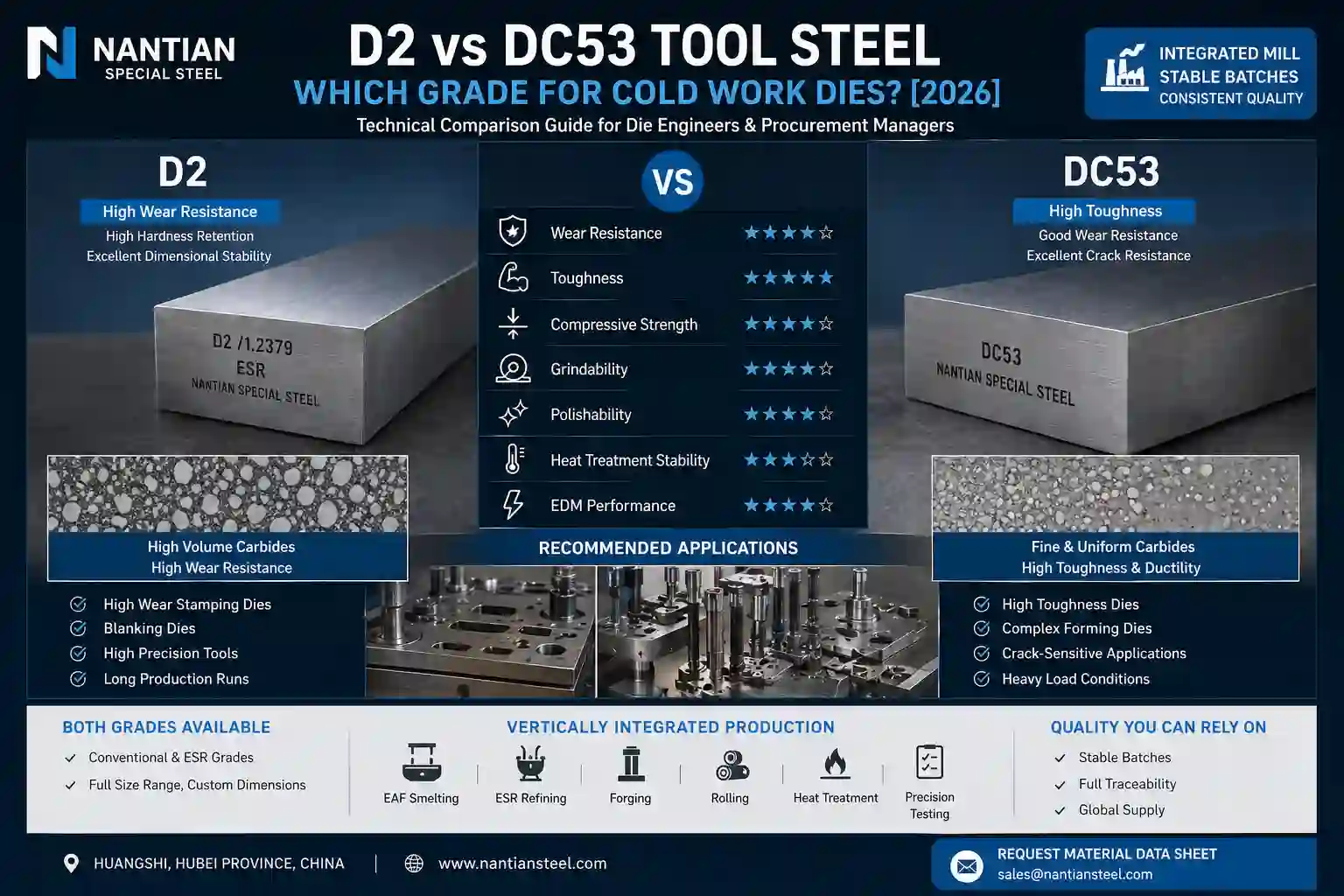
Table of Contents
Carbide Morphology: The Real Reason D2 and DC53 Behave Differently
ESR D2 vs Conventional D2 — Why the Production Route Changes Everything
Heat Treatment Response: Quench, Temper, and Dimensional Stability
Chemistry Side by Side: Where the Differences Start
D2 (ASTM A681) and DC53 are both high-chromium cold work tool steels, but their chemistry philosophies diverge significantly. D2 prioritizes maximum carbide volume fraction through high carbon (1.40–1.60%) and high chromium (11.0–13.0%). DC53 takes a different route: lower carbon (0.95–1.05%) and moderate chromium (~8%), with higher molybdenum and vanadium additions to compensate.
| Element | D2 / 1.2379 / SKD11 / Cr12Mo1V1 | DC53 | Effect of Difference |
|---|---|---|---|
| Carbon (C %) | 1.40–1.60 | 0.95–1.05 | Higher C in D2 → more carbide volume → better wear resistance, lower toughness |
| Chromium (Cr %) | 11.0–13.0 | 7.9–8.5 | D2's higher Cr forms large Cr₇C₃ / Cr₂₃C₆ carbides; DC53's lower Cr gives finer distribution |
| Molybdenum (Mo %) | 0.70–1.20 | 1.50–2.10 | Higher Mo in DC53 improves secondary hardening and hardenability at depth |
| Vanadium (V %) | 0.50–1.10 | 0.25–0.45 | D2's V forms hard MC carbides; contributes to wear resistance at grain boundaries |
| Silicon (Si %) | 0.10–0.60 | 0.80–1.20 | DC53's higher Si improves temper resistance and contributes to secondary hardening response |
The chemistry gap explains why these grades behave differently in heat treatment and in service — but chemistry alone doesn't tell you which to choose. The more important variable is what happens to those carbides during solidification and forging, and that's where ESR enters the conversation.
Carbide Morphology: The Real Reason D2 and DC53 Behave Differently
Carbide morphology refers to the size, shape, distribution, and spacing of carbide particles within the steel matrix. It is, by a significant margin, the most important microstructural variable in cold work tool steel performance — more predictive of die life than hardness alone, and more difficult to control than chemistry.
Here's the problem with D2 specifically. Its high carbon and chromium content means carbides form early during solidification, grow large in the as-cast ingot, and tend to segregate along dendritic boundaries. If the subsequent forging reduction is insufficient to break up these primary carbides, they persist as angular clusters in the finished bar — and those clusters are crack initiation sites under cyclic loading.
Why Do D2 Dies Sometimes Crack Along Carbide Bands?
The failure mechanism is well-documented in tool steel metallurgy literature. Angular or clustered Cr₇C₃ carbides — typically 5–20 µm in size in conventionally processed D2 — create stress concentrations at the carbide-matrix interface under compressive and tensile cycling. When fatigue cracks initiate at these sites and link up along a banded carbide layer, the result looks like brittle fracture even though the bulk hardness is within spec. The MTC shows everything normal. The die still cracks at 80,000 cycles instead of 200,000.
DC53 avoids this problem by design. Its lower carbon and chromium content means fewer and finer carbides form during solidification. The carbide population in properly processed DC53 consists primarily of fine M₆C and MC types, more evenly distributed, with fewer angular morphologies. That's why DC53 shows higher impact toughness values than D2 — roughly 1.5–2× higher in Charpy tests at equivalent hardness levels — and why it tends to fail by gradual wear rather than sudden fracture in demanding die geometries.
Does DC53 Always Have Better Carbide Distribution Than D2?
Short answer: in conventional production, yes. Long answer: it depends on the production route of the D2.
ESR (electroslag remelting) fundamentally changes D2's carbide morphology by controlling the solidification rate and removing impurities through reactive slag. The result — as we measure routinely in our own metallographic section analysis — is a D2 with carbide size and distribution approaching DC53's uniformity, while retaining D2's higher carbide volume fraction (and therefore its wear resistance advantage).
That's not a theoretical claim. It's a measurable difference under the microscope, and it changes the grade selection logic entirely for certain applications. I'll cover ESR D2 in detail in the next section.
ESR D2 vs Conventional D2 — Why the Production Route Changes Everything
Electroslag remelting (ESR) is a secondary refining process in which a consumable D2 electrode is remelted through a molten reactive slag under controlled atmosphere. The slag acts as both a filter (removing oxide and sulfide inclusions) and a thermal regulator (slowing solidification to produce a finer, more uniform as-cast structure). The resulting ingot has lower dissolved gas content, fewer non-metallic inclusions, and — critically for D2 — a more uniform carbide distribution from surface to core.
At Nantian, we run ESR through two Austrian-imported INTECO atmosphere-protection furnaces: an 8-ton unit and a 16-ton unit, producing rod ingots from φ250mm to φ1042mm. The atmosphere protection prevents oxidation during remelting — a step that matters for high-chromium grades like D2 where surface oxidation during conventional ESR can affect chromium content at the ingot periphery.
What Measurable Improvements Does ESR Deliver in D2?
Based on our production data comparing conventional arc-melted D2 and INTECO ESR D2 of equivalent chemistry:
Carbide size: Primary carbide diameter reduced from a typical 8–18 µm range (conventional) to 3–8 µm (ESR) — finer carbides mean more crack-resistant interfaces
Carbide distribution uniformity: Eutectic carbide network banding significantly reduced; more homogeneous distribution across the full cross-section
Inclusion rating: Non-metallic inclusion content reduced by approximately 40–60% vs. conventional arc melt, per ASTM E45 rating methodology
Gas content: H₂ ≤ 2 ppm, O₂ ≤ 15 ppm — levels comparable to vacuum arc remelted (VAR) grades at lower cost
Hardness uniformity: Cross-section hardness variation of ≤ 1.5 HRC vs. up to 3–4 HRC variation possible in large conventional D2 sections
When Is ESR D2 the Right Choice Over DC53?
ESR D2 makes the most sense when your primary failure mode is wear, not chipping — but you've been experiencing inconsistent die life suggesting carbide-related fracture initiation on a subset of heats. You want D2's wear resistance but without the carbide banding lottery of conventional production. ESR removes the lottery.
DC53 remains the better choice when: your failure mode is confirmed chipping or cracking regardless of steel source; your die geometry has thin features or sharp re-entrant angles where toughness trumps everything; or your heat treatment facility optimizes for DC53's specific 520–540°C high-temp temper cycle.
Hardness and Toughness: Full Data Comparison
| Property | D2 / 1.2379 (Conventional) | D2 / 1.2379 (ESR Grade) | DC53 |
|---|---|---|---|
| Hardness after HT (HRC) | 60–62 | 61–63 | 62–64 (high-temp temper) |
| Cross-section hardness variation | Up to ±3–4 HRC (large sections) | ≤ ±1.5 HRC | ≤ ±2 HRC |
| Charpy impact toughness (relative) | Baseline (1×) | ~1.3–1.5× | ~1.8–2.2× |
| Wear resistance (relative) | Excellent (3×) | Excellent (3×) | Good (2×) |
| Primary carbide size (µm) | 8–18 µm | 3–8 µm | 2–6 µm |
| Carbide banding risk | Moderate–High | Low | Low |
| Non-metallic inclusion level | Standard | 40–60% lower vs conv. | Standard |
| Typical annealed hardness (HB) | ≤ 255 HB | ≤ 255 HB | ≤ 255 HB |
Read the ESR D2 column carefully. It doesn't match DC53 on toughness — DC53 is still the tougher grade in absolute terms. But ESR D2 closes roughly half the toughness gap compared to conventional D2, while maintaining D2's superior wear resistance. For applications where both wear and toughness matter — which is most precision blanking and progressive die work — ESR D2 often delivers a better overall outcome than either conventional D2 or DC53.
Big difference. And most engineers never consider it because their supplier doesn't offer ESR D2 as a distinct product.
Heat Treatment Response: Quench, Temper, and Dimensional Stability
Both D2 and DC53 are air-hardening grades — meaning they reach full hardness by cooling in still air or inert gas after austenitizing, without requiring oil or water quenching. That said, their optimal heat treatment windows differ, and confusing them is a common source of below-spec results.
D2 / 1.2379 Heat Treatment Parameters
Austenitizing: 1000–1040°C (1832–1904°F), hold 20–30 min at temperature
Quench: Air cool or inert gas quench; oil quench for complex sections to minimize thermal gradient
Tempering (standard): 180–200°C for maximum hardness (~62 HRC); double temper recommended
Tempering (high-temp): 525±5°C for secondary hardening — produces 60–62 HRC with improved toughness and stress relief; critical for wire-EDM applications
Dimensional change during HT: Low — typically +0.05% to +0.08% in the rolling direction; D2's air-hardening characteristic minimizes quench distortion
DC53 Heat Treatment Parameters
Austenitizing: 1020–1050°C, hold 20–30 min
Quench: Air cool or high-pressure gas (N₂) quench
Tempering: DC53's key advantage is its response to high-temperature tempering at 520–540°C — produces 62–64 HRC through strong secondary hardening, while simultaneously relieving quench stresses and reducing wire-EDM residual stress significantly
Dimensional change: Slightly lower than D2 at equivalent section size — the reduced carbide volume means less volumetric strain during the austenite-to-martensite transformation
Worth mentioning: the tempering temperature difference between D2 and DC53 is consequential if your heat treater uses a generic "tool steel" cycle without specifying the grade. D2 tempered at 300–400°C — a temperature range where both grades show a tempered martensite embrittlement trough — will have substantially lower toughness than the same steel tempered at 180°C or 525°C. It's a real-world failure mode I've seen multiple times. Always specify the tempering temperature by grade, not just by target hardness.
Wire-EDM Behavior and Residual Stress
For die components manufactured by wire electrical discharge machining (wire-EDM), the residual stress state after heat treatment matters as much as bulk hardness. Wire-EDM introduces tensile surface stresses during the cutting process. In steel with high pre-existing internal stress — either from quenching or from locked-in carbide transformation stresses — the additive effect can cause cracking during cutting or distortion after sectioning.
Why Does DC53 Show Lower EDM Residual Stress Than D2?
DC53's high-silicon composition and high-temperature tempering cycle (520–540°C) produce a more fully stress-relieved martensitic matrix before wire-EDM begins. The lower carbide volume fraction also means fewer carbide-matrix interface stresses locked into the microstructure. Published data from DC53's developer indicates residual stress levels in the EDM heat-affected zone approximately 30–40% lower than conventional D2 tempered under standard conditions.
Not exactly a trivial number for fine-pitch progressive die components where post-EDM distortion of ±0.005mm can push a punch outside tolerance.
Does ESR D2 Improve EDM Behavior Compared to Conventional D2?
Yes — measurably. The lower inclusion content and more uniform carbide distribution in ESR D2 reduce the internal stress heterogeneity that amplifies EDM-induced stresses. ESR D2 combined with high-temperature tempering at 525±5°C performs significantly better than conventional D2 in wire-EDM applications — closer to DC53 territory, though DC53 still has the edge for the most demanding fine-pitch work.
Practical rule of thumb from our production experience: for EDM-intensive die components with feature tolerances ≥ ±0.01mm, DC53 or ESR D2 (high-temp temper) are both viable choices. Below ±0.008mm, DC53 is the safer specification.
Decision Matrix: Which Grade for Which Die?
| Application / Condition | Recommended Grade | Reason |
|---|---|---|
| High-cycle blanking on mild/medium steel, long run > 500K cycles | D2 / ESR D2 | Wear resistance advantage over DC53 sustains longer intervals between regrind |
| Complex geometry die with thin sections or re-entrant angles | DC53 | Higher toughness reduces chipping risk at stress concentrations |
| Blanking / forming AHSS or UHSS (> 800 MPa tensile strength) | DC53 | High-strength workpiece material increases die stress; DC53's toughness margin provides safety factor |
| Large section die (cross-section > 80mm), wear is primary failure mode | ESR D2 | Conventional D2 carbide banding is most severe at large sections; ESR removes that variable while preserving wear resistance |
| Wire-EDM intensive components, tolerance ≤ ±0.01mm | DC53 or ESR D2 (high-temp temper) | Lower residual stress and more uniform microstructure reduce EDM-induced distortion |
| Cold forging dies, deep-drawing tools under high compressive stress | DC53 or Cr12MoV | Toughness and compressive yield strength more critical than abrasive wear resistance |
| Standard blanking punches, moderate-volume production (< 200K cycles) | D2 (conventional) | Excellent wear performance at lowest cost per cycle; ESR premium not justified at this volume |
| Inconsistent die life between batches (same D2 grade, different heats) | ESR D2 | Symptom of carbide banding from inconsistent source; ESR removes heat-to-heat variability |
A few notes on reading this table. "Inconsistent die life between batches" is the row that catches most engineers off-guard. If your D2 dies are running 150K cycles from one delivery and 80K from the next, with identical heat treatment and the same workpiece material, the problem is almost certainly carbide distribution variation between heats — not your heat treatment, not your die design. ESR D2 from a single integrated mill (where the ESR ingot, forging, and rolling are all traceable to one heat number) eliminates that variable.
Sourcing D2 and DC53 from Nantian: Specs and ESR Options
We produce both grades in-house — same facility, same quality inspection protocol, same documentation standard. Here's what that means in practice for your order:
D2 / 1.2379 — Standard and ESR Grade
Round bars: φ12–360mm (GFM radial forged φ70–250mm, accuracy 0–1mm, length up to 8.5m)
Plates / flat bars: Thickness 1–360mm × Width 30–1020mm
Delivery condition: Annealed + sandblasted, hardness ≤ 255 HB
ESR option: Available via INTECO 8t/16t ESR furnace; specify at inquiry — added lead time ~7–10 working days
MOQ: 5 tons (standard); 10 tons (ESR grade or custom dimensions)
DC53
Round bars: φ12–250mm
Plates: Thickness 5–200mm × Width 30–700mm
Delivery condition: Annealed, hardness ≤ 255 HB
MOQ: 3 tons
Quality Documentation (Both Grades)
MTC per EN 10204 Type 3.1 with full chemistry, hardness data, and UT result (SEP1921)
QR code on every plate head / bar end — links to digital inspection record for that specific piece
Metallographic report (carbide rating, decarburization depth, grain size) available on request
Third-party inspection (SGS / Bureau Veritas / Intertek) coordinated on request
→ See full cold work tool steel range with specs
→
Request a D2 or DC53 quote with ESR availability
and lead time
Email:
hbntkj@nantiansteel.com
| WhatsApp: +8618007237687
Frequently Asked Questions
What is the main difference between D2 and DC53 tool steel?
D2 (1.2379 / SKD11) has higher carbon (1.40–1.60%) and chromium (11–13%), giving it superior wear resistance. DC53 uses lower carbon (~1.0%) with higher molybdenum and silicon, producing better toughness (approximately 1.8–2× D2 in Charpy testing) and lower residual stress after wire-EDM. D2 is the default choice for wear-dominated failures; DC53 for toughness-dominated failures.
Is DC53 always tougher than D2?
In conventional production, yes — DC53 shows higher impact toughness at equivalent hardness. However, ESR-grade D2 (electroslag remelted) closes roughly half that gap by refining carbide morphology and reducing inclusion content. For applications where both wear and toughness matter, ESR D2 often outperforms both conventional grades.
What is ESR D2 and why does it perform better than conventional D2?
ESR D2 is produced by remelting a conventional D2 electrode through reactive slag under atmospheric protection. This refines primary carbide size from 8–18 µm to 3–8 µm, reduces non-metallic inclusions by 40–60%, and improves cross-section hardness uniformity to ≤ ±1.5 HRC. The result is D2 with DC53-like carbide uniformity but D2-level wear resistance.
Which is better for wire-EDM die components — D2 or DC53?
DC53 is generally better for wire-EDM applications due to lower residual stress after high-temperature tempering (520–540°C). For tolerances ≤ ±0.008mm, DC53 is the safer specification. ESR D2 with high-temp tempering at 525±5°C is a viable alternative for tolerances in the ±0.01mm range.
What hardness can D2 reach after high-temperature tempering?
D2 tempered at 525±5°C (secondary hardening peak) reaches 60–62 HRC on conventional grade and 61–63 HRC on ESR grade. High-temperature tempering also relieves quench stresses and improves toughness compared to low-temperature tempering at 180–200°C, which produces maximum hardness (62–63 HRC) but lower toughness.
Does DC53 have better hardenability than D2 in large sections?
In sections above 100mm, DC53's higher molybdenum content (1.5–2.1%) gives it somewhat better hardenability depth than conventional D2. ESR D2's reduced inclusion content and finer carbide distribution improve its hardenability response, narrowing this gap. For critical large-section die blocks, specifying ESR D2 is recommended over conventional D2.
Can I use D2 for stamping high-strength steel (AHSS / UHSS)?
It depends on the specific application. Conventional D2 is marginal for AHSS above 800 MPa tensile strength due to chipping risk on complex die features. DC53 is the standard recommendation for AHSS/UHSS stamping. ESR D2 can work for AHSS applications with simple die geometry and wear-dominated failure modes, but DC53 is the lower-risk choice for complex geometries.
Where can I get D2 and DC53 directly from a Chinese manufacturer with full MTC?
Nantian produces both grades in-house at our Huangshi, Hubei facility — smelting, forging, rolling, and inspection all under one management system. We issue MTCs per EN 10204 Type 3.1, QR-code every piece to a traceable inspection record, and offer ESR-grade D2 through our Austrian INTECO system. Contact hbntkj@nantiansteel.com for specs and lead time.
Making the Grade Decision: A Final Checklist
D2 and DC53 are both excellent cold work steels. The choice between them is not about which grade is "better" — it's about which failure mode you're solving for.
Wear is your bottleneck → D2 (standard or ESR depending on section size and consistency requirements)
Chipping or cracking is your bottleneck → DC53, especially for complex geometry or AHSS workpieces
Inconsistent die life between D2 batches → ESR D2 from an integrated mill — removes the carbide banding variable entirely
Heavy wire-EDM with tight tolerances → DC53 or ESR D2 with high-temp tempering at 525±5°C
Large section (> 80mm) + wear-critical → ESR D2 — conventional D2's carbide non-uniformity is most severe at large cross-sections
One more thing. Whatever grade you select, the production route of the steel matters as much as the grade designation on the MTC. Two D2 bars with identical chemistry can perform very differently if one was forged with adequate carbide breakup reduction and one wasn't. Ask for the forging reduction ratio, the annealing cycle record, and a metallographic section report on the first order. If the supplier can't provide those, you're buying chemistry certificates, not quality steel.
→
Request D2 / ESR D2 / DC53 samples or a technical
data sheet from Nantian
hbntkj@nantiansteel.com
| WhatsApp: +8618007237687
About the Author
Ajiao Liu is Export Manager at Hubei Nantian Tool and Mold Technology Co., Ltd., Huangshi, Hubei, China. She liaises between Nantian's metallurgical engineering team and international buyers, translating production data into grade selection guidance for die engineers and toolroom procurement managers across Europe, Asia, and the Middle East. Contact: hbntkj@nantiansteel.com | +8618007237687.