
By Ajiao Liu | Nantian Steel Export Team | Updated March 2026
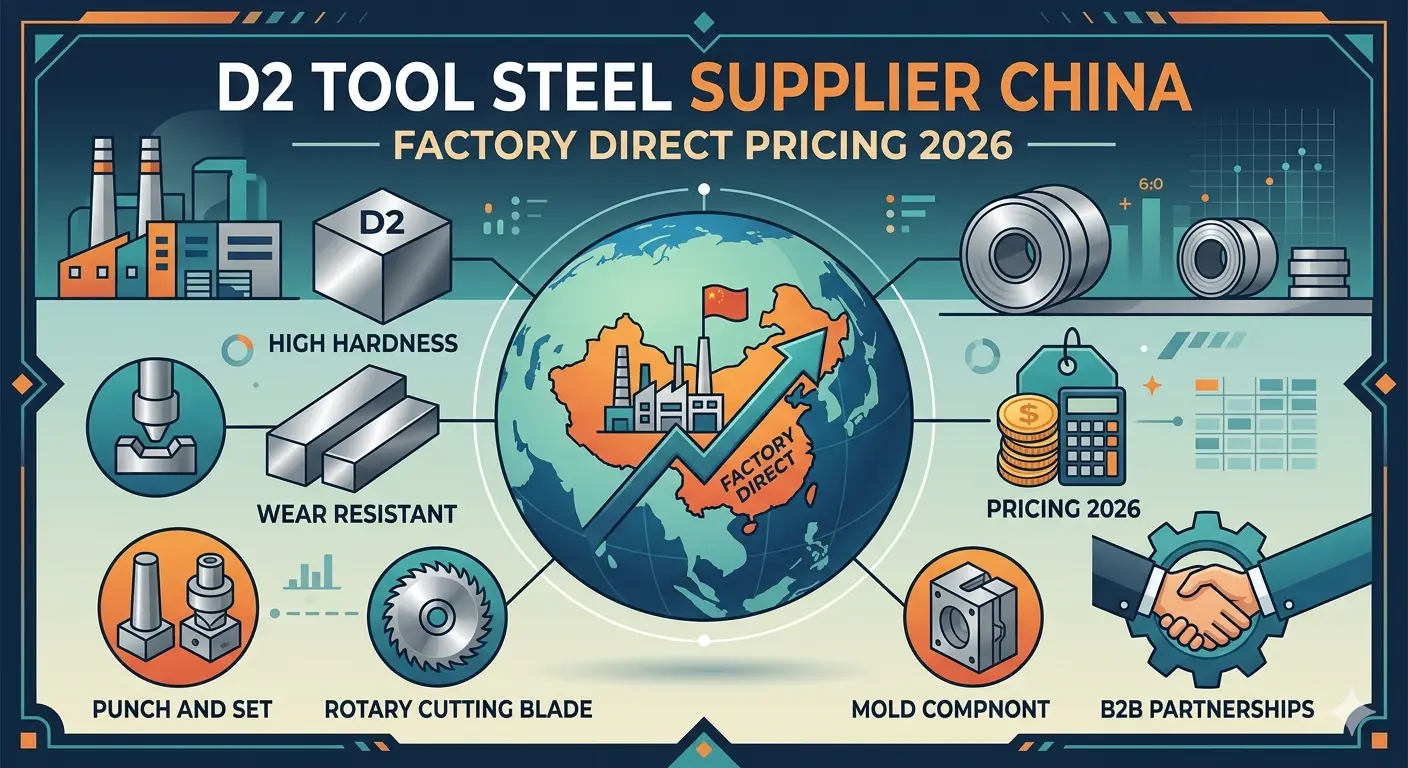
Buying D2 tool steel from China through a trading company typically adds 10–20% markup before the steel even leaves port. That margin hits your bottom line on every order—and you still don't know which mill actually made the material. Nantian is the mill. We smelt, forge, roll, and ship D2 / 1.2379 / SKD11 / Cr12Mo1V1 from our own 300,000-ton-per-year facility in Huangshi, Hubei Province, with full traceability from furnace to your warehouse.
This guide breaks down exactly what you get—and what you avoid—when sourcing D2 cold work tool steel factory-direct from a vertically integrated Chinese steelmaker in 2026.
Written by the export team at Nantian (Hubei Nantian Tool and Mold Technology Co., Ltd.), operating five forging and rolling lines, Austrian GFM radial forging, and INTECO ESR systems. We supply mold makers and steel distributors across Europe, the Americas, Southeast Asia, and the Middle East.
Table of Contents
What Exactly Is D2 / 1.2379 Tool Steel?
D2 is a high-carbon (1.40–1.60% C), high-chromium (11.00–13.00% Cr) cold work tool steel classified under ASTM A681. Its European equivalent is DIN 1.2379 (X155CrVMo12-1), the Japanese equivalent is JIS SKD11, and the Chinese national standard grade is Cr12Mo1V1 (GB/T 1299). All four designations share nearly identical chemistry and are treated as interchangeable in most industrial tooling contexts—though minor spec differences in vanadium and silicon limits do exist between SKD11 and D2.
Why Does D2 Dominate Cold Stamping Applications?
Two words: wear resistance. The high chromium and carbon content forms large volumes of hard carbides in the microstructure, giving D2 excellent abrasion resistance and edge retention at hardness levels of 60–62 HRC. It's air-hardening, which means minimal distortion during heat treatment—critical when you're running precision blanking dies or thread rolling dies with tight tolerances.
Typical applications: blanking dies, forming dies, cold-forging dies, slitting cutters, shear blades, drawing dies, lamination dies, and precision stamping tools. If your die runs long production cycles under high compressive stress and abrasive conditions, D2 is likely already on your shortlist.
That said—D2 isn't perfect for everything. Its toughness is lower than grades like DC53 or 8Cr13MoV. For applications involving heavy shock loading or complex die geometries prone to chipping, you may want to consider modified grades. I'll cover that comparison below.
Factory Direct vs. Trading Company: Where Does Your Money Go?
Here's the catch when sourcing D2 through intermediaries. A typical export trading company in China buys steel from one mill (sometimes two), repackages the documentation, and adds a 10–20% markup. You pay more—and get less transparency on where the steel was actually produced, which heat it came from, or what happened during quality inspection.
How Much Can You Actually Save Buying Factory Direct?
On a 25-ton order of D2 flat bar, the difference between trader pricing and mill pricing typically runs 15–25% per ton depending on specification complexity. For a European procurement manager buying 100+ tons annually, that delta alone can cover your shipping costs.
But price isn't the only factor. Worth mentioning: when you deal with the mill, you get direct access to our metallurgical engineers. Questions about tempering parameters for a specific die geometry? Tolerance adjustments for a non-standard plate width? Those conversations happen without a middleman translating—or filtering—the technical details.
What Does "Vertically Integrated" Actually Mean for Your Order?
Vertical integration means Nantian controls the entire production chain internally: electric arc furnace smelting → external refining (LF) → vacuum degassing (VD) → forging (3000-ton press or GFM radial forging machine) → rolling (950/750/650 lines) → annealing (100m nitrogen-protected continuous spheroidization furnace) → quality testing → packaging → shipment. No outsourced steps. No unknown sub-suppliers.
That matters. When a quality issue arises—say, a batch shows slightly elevated carbide banding—we trace it to the specific ladle, adjust refining parameters, and re-verify within hours. A trader? They file a complaint with whoever made it and wait.
How Nantian Produces D2—From Melt Shop to Loading Dock
Our D2 production route starts with an electric arc furnace, followed by ladle refining and vacuum degassing to control gas content (O₂, H₂, N₂) and reduce non-metallic inclusions. For customers requiring ultra-clean D2—typically those making precision stamping dies for electronics or connector parts—we offer electroslag remelting (ESR) through our Austrian-imported INTECO system.
What Does ESR Do for D2 Quality?
Electroslag remelting (ESR) is a secondary refining process where a consumable electrode is remelted through reactive slag under atmospheric protection. The result: lower gas content, smaller and more evenly distributed carbides, and a cleaner grain boundary structure. Our INTECO setup includes an 8-ton and a 16-ton ESR furnace, producing rod ingots from 250mm to 1042mm diameter.
Is ESR necessary for every D2 order? Honestly, no. For standard cold-work dies running at moderate production volumes, conventionally refined D2 performs fine. ESR makes a measurable difference when you need repeatable hardness uniformity across large cross-sections, or when your die design has thin features prone to cracking at carbide clusters. I've had a mold maker in Stuttgart switch to ESR-grade D2 for a 500,000-cycle connector die and cut his scrap rate from 3.2% to under 0.8%.
Forging and Rolling: How Specifications Are Achieved
For round bars (φ70–250mm), we use the GFM radial forging machine imported from Austria—270 to 500 strokes per minute, dimensional accuracy within 0–1mm, forging length up to 8.5m. Smaller diameters (φ12–70mm) go through our 650 and 750 rolling lines.
Plates and flat bars (thickness 1–360mm, width 30–1020mm) are rolled on our 950 production line with high-pressure water and high-pressure wind descaling for maximum surface cleanliness. Every plate passes through the 100m nitrogen-protected continuous spheroidization annealing furnace before final straightening on our 2000-ton hydraulic press.
Delivery condition: annealed with black skin + sandblasting, hardness ≤ 255 HB (or per contract specification).
Quality Control and QR Traceability: What's in Your MTC
Every D2 plate and bar leaving Nantian goes through six inspection stages. This isn't a marketing bullet point—it's the sequence that determines whether steel ships or gets held.
Chemical Composition: Verified using a German mobile spectrometer and line spectrograph. Results must fall within ASTM A681, DIN EN ISO 4957, or contract-specific ranges.
Tolerance Testing: Thickness and width verified against factory or contract tolerances.
Straightness & Flatness: Checked with 1m, 2.5m, and 5m aluminum straight rulers—both within 1mm/m.
Hardness: Leeb hardness tester, multiple points per piece, averaged. Must fall within ≤ 255 HB for annealed delivery or per contract.
Ultrasonic Testing: Performed per SEP1921 standard to detect internal voids, inclusions, and laminations.
Metallographic Inspection: Macro/microstructure, non-metallic inclusions, eutectic carbide level, decarburization layer thickness, and gas content (N₂, H₂, O₂).
Why the QR Code on Every Plate Head?
Each plate head is stamped with a QR code linked to that plate's complete production and inspection record—heat number, ladle composition, rolling date, UT results, hardness readings, and MTC. Scan it with your phone at your receiving warehouse. No paperwork hunting. No guessing which heat your plate came from.
We issue MTCs compliant with EN 10204 Type 3.1. If your purchasing spec requires additional testing (e.g., impact testing, specific carbide rating per ASTM E45), flag it at contract stage and we build it into the QC protocol.
D2 vs. DC53 vs. SKD11—Which Grade Fits Your Die?
| Property | D2 / 1.2379 | DC53 | SKD11 (JIS) |
|---|---|---|---|
| Carbon (%) | 1.40–1.60 | 0.95–1.05 | 1.40–1.60 |
| Chromium (%) | 11.00–13.00 | 11.00 | 11.00–13.00 |
| Hardness after HT (HRC) | 60–62 | 62–63 (high-temp temper) | 60–62 |
| Toughness (relative) | Moderate | Higher than D2 | Similar to D2 |
| Wear Resistance | Excellent | Good (slightly lower) | Excellent |
| Wire-EDM Stress | Moderate residual stress | Lower residual stress | Moderate residual stress |
| Best For | Long-run blanking, forming dies | Complex dies, cold forging | General cold work, punches |
The real decision comes down to your failure mode. If your dies wear out, D2 is the right call. If your dies crack or chip, DC53 gives you better toughness at equivalent or higher hardness—especially after high-temperature tempering at 525±5°C, where DC53 can reach 62–63 HRC with significantly less residual stress after wire-EDM cutting.
Quick example. A European automotive parts stamper running 1.2mm stainless steel blanking at 200+ strokes per minute was burning through D2 punches every 80,000 hits due to micro-chipping. We switched them to our DC53 with ESR, same die geometry. Die life jumped to 180,000+ hits. Not every application sees that gain—but when chipping is your bottleneck, the grade swap pays for itself fast.
Nantian produces all three grades in-house. If you're unsure which fits your application, send us your die drawing and target production volume.
Ordering: Specs, MOQ, Lead Time, and Delivery Terms
What Sizes Can Nantian Supply in D2?
Round bars: φ12–360mm (GFM forged: φ70–250mm × up to 8.5m length)
Plates/Flat bars: Thickness 1–360mm, Width 30–1020mm
Custom cutting and non-standard dimensions available on request
How Long from PO to Port?
Standard grades in stock sizes: 15–20 days production + domestic logistics. Custom sizes or ESR material: 25–35 days. We provide production status updates weekly—no black-box waiting.
Delivery status: annealed black skin + sandblasted surface, hardness ≤ 255 HB (or per contract). Round bars above φ200mm ship bundled; smaller diameters in bulk or per your packing spec.
Markets we ship to regularly: Germany, Italy, Turkey, the US, Brazil, Thailand, India, the UAE. Container loading optimization available for mixed-grade orders.
Frequently Asked Questions
Are you a D2 tool steel manufacturer or a trading company?
We are the manufacturer. Nantian operates its own steelmaking, forging, and rolling lines on a 300-acre facility in Huangshi, Hubei, with over 700 employees and 300,000 tons annual capacity. Every piece of D2 we sell is produced in our own plant.
What certifications does Nantian hold?
We hold Quality Management System, Environmental Management System, and Occupational Health and Safety Management System certificates. MTCs are issued per EN 10204 Type 3.1 with full chemical and mechanical data.
What is the MOQ for D2 / 1.2379 round bars?
Standard MOQ is 5 tons per specification for stock grades. For ESR-grade or custom dimensions, MOQ may be 10 tons. Contact us with your specific requirement—we accommodate mixed-size orders within a single spec.
Can I get D2 steel with ESR (electroslag remelting)?
Yes. We run two INTECO atmosphere-protection ESR furnaces (8-ton and 16-ton). ESR D2 delivers lower gas content, finer carbide distribution, and more consistent hardness across sections. Specify "ESR" at inquiry and we'll quote accordingly.
How do I verify the quality of D2 imported from China?
Request the MTC with heat number, scan the QR code on the plate/bar head to access full inspection data, and conduct your own incoming inspection per your QC protocol. We perform UT to SEP1921, chemical verification via spectrometer, and hardness testing on every piece. Third-party inspection (SGS, Bureau Veritas) can be arranged at your request.
What is the typical hardness of D2 in annealed delivery condition?
≤ 255 HB. This is the standard annealed condition for machining. After heat treatment (quenching at 1010–1040°C + tempering), D2 reaches 60–62 HRC depending on tempering temperature and cycle.
Do you ship D2 steel to Europe?
Yes. Europe is one of our core markets—Germany, Italy, Poland, Turkey, and the UK among the most frequent destinations. We provide dedicated line shipping to reduce transit delays and offer FOB, CIF, and CFR terms.
What's the difference between forged D2 bars and rolled D2 bars?
Forged bars (produced on our GFM or 3000-ton press) have superior internal density, more uniform grain flow, and reduced centerline porosity—ideal for high-performance die applications. Rolled bars are cost-effective for standard applications. We produce both and can advise based on your use case.
Ready to Source D2 Factory-Direct?
Here's what buying D2 from Nantian comes down to:
Mill-direct pricing—no trading company markup
Full-chain traceability—QR code on every piece, MTC per EN 10204/3.1
ESR option—Austrian INTECO system for applications demanding ultra-clean steel
φ12–360mm rounds + 1–360mm thick plates—produced on our own forging and rolling lines
Six-stage quality inspection—chemistry, tolerance, flatness, hardness, UT (SEP1921), metallography
→ Get a D2 / 1.2379 Quote with Full Spec Sheet
Or email Ajiao Liu directly at hbntkj@nantiansteel.com | WhatsApp: +8618007237687
About the Author
Ajiao Liu is the Export Manager at Hubei Nantian Tool and Mold Technology Co., Ltd., based in Huangshi, China. With hands-on involvement in Nantian's production and export operations, she works directly with mold makers, steel distributors, and procurement teams in Europe, the Americas, Southeast Asia, and the Middle East. Reach her at hbntkj@nantiansteel.com or on WhatsApp at +8618007237687.