

By Ajiao Liu | Nantian Steel Export Team | Updated April 2026
Batch inconsistency is the failure mode that kills cold-work die programs. Not the first shipment — that one usually passes incoming inspection. It's the third batch, or the sixth, where hardness drifts 4 HRC points, carbide banding shifts, and your stamping line starts generating scrap. By that point you've already committed to a supplier, and switching mid-program is expensive.
The root cause, almost every time: the steel passed through too many hands before it reached you. A trader sourcing from two or three different mills depending on stock availability cannot guarantee batch-to-batch metallurgical consistency — because they don't control the furnace.
Nantian does. We are a vertically integrated cold work tool steel manufacturer based in Huangshi, Hubei Province, China — operating our own electric arc furnace, ladle refining, vacuum degassing, Austrian GFM radial forging, and five rolling lines on a single 300-acre site. Every kilogram of D2, DC53, Cr12, and Cr12MoV that leaves our gate was smelted, forged, rolled, annealed, tested, and QR-coded by us. Annual capacity: 300,000 tons.
This page is for procurement managers in the UAE, Saudi Arabia, and the wider Gulf region who are evaluating cold work tool steel suppliers and need to make a defensible sourcing decision — with documentation to match.
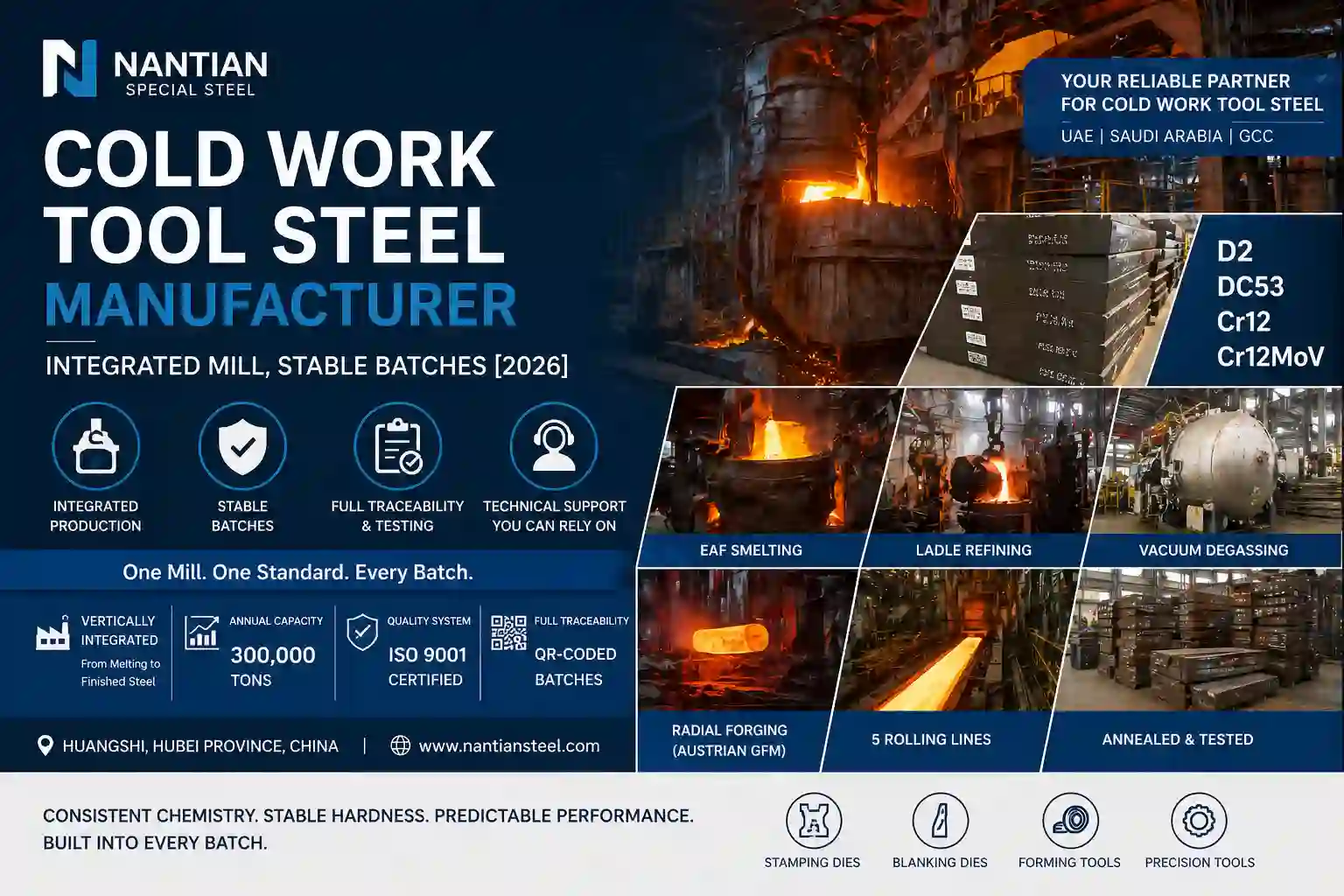
Table of Contents
What Is Cold Work Tool Steel — and Why Does Grade Selection Matter?
The Batch Consistency Problem: Why Your Supplier's Supply Chain Is Your Risk
Nantian's Integrated Process: Smelting → Forging → Rolling → QC
Cold Work Tool Steel Grades We Produce: Full Specification Reference
Quality Documentation for Gulf Importers: MTC, QR Traceability, and Third-Party Inspection
Ordering for Middle East Delivery: MOQ, Lead Time, Incoterms, and Port Routing
What Is Cold Work Tool Steel — and Why Does Grade Selection Matter?
Cold work tool steel is a category of alloy steel engineered for tooling applications that operate at or near ambient temperature — typically below 200 °C — under high compressive stress, abrasive contact, and repeated impact. The defining requirement is maintaining hardness and dimensional stability throughout the tool's service life without relying on elevated-temperature strength.
The "cold" designation does not mean the steel is processed cold. It means the application runs cold. Blanking punches, forming dies, cold-forging tooling, slitting cutters, thread rolling dies, deep-drawing tools — all of these are cold-work applications. The steel is heat-treated to high hardness (typically 58–64 HRC depending on grade) before service, and then expected to resist wear and cracking at that hardness level throughout a production run of hundreds of thousands of cycles.
Which Cold Work Steel Grade Is Right for Stamping and Forming Dies?
Grade selection comes down to three competing properties: wear resistance, toughness, and dimensional stability during heat treatment. No single grade maximizes all three simultaneously — which is why cold work tool steel exists as a family of grades, not a single material.
High-chromium grades like D2 (ASTM) / 1.2379 (DIN) / SKD11 (JIS) / Cr12Mo1V1 (GB) prioritize wear resistance at the expense of toughness. Oil-hardening grades like O1 / 1.2510 offer better toughness but lower wear resistance. Modified grades like DC53 attempt to close the toughness gap while preserving hardness — and largely succeed, at a higher cost. I'll lay out the full comparison below.
One thing I always tell procurement managers evaluating cold work steel for the first time: your die failure mode tells you more about grade selection than any spec sheet. If dies wear out, go higher chromium. If they chip or crack, go tougher. If they distort after heat treatment, go to an air-hardening or vacuum-hardening grade with better dimensional stability.
The Batch Consistency Problem: Why Your Supplier's Supply Chain Is Your Risk
Here is something that does not appear in any supplier brochure: a significant portion of cold work tool steel sold through Chinese trading companies is sourced opportunistically — meaning the trader buys from whichever mill has stock at the right price at the time of your order. Your first purchase might come from Mill A. Your third order comes from Mill B. The MTC says the same grade designation, but the carbide morphology, inclusion level, and hardenability response can differ measurably between mills.
What Does Batch Inconsistency Actually Look Like in Production?
An automotive stamping operation in the Gulf region shared this with me last year: they were running D2 blanking punches sourced through a regional distributor, achieving consistent 120,000-cycle life on batches 1 through 4. Batch 5 started chipping at 60,000 cycles. Incoming hardness was within spec. Chemical composition on the MTC looked fine. The problem was carbide banding — a microstructural non-uniformity caused by insufficient forging reduction or improper annealing. It wasn't visible without metallographic section.
That's the failure mode that integrated manufacturing prevents. When we forge a D2 bar on our 3,000-ton precision forging press or GFM radial forger, the reduction ratio is controlled. When it goes through our 100-meter nitrogen-protected spheroidization annealing furnace, the carbide globularization cycle is controlled. When it comes out, we cut a metallographic section and check carbide distribution before it ships.
How Does Vertical Integration Fix the Consistency Problem?
Vertical integration in steelmaking means a single entity controls every production step from raw material charge to finished, inspected product — with no outsourced processing nodes where quality variables can be introduced or documentation can be fabricated.
At Nantian, the sequence is fixed and internally audited: electric arc furnace → ladle refining furnace (LF) → vacuum degassing (VD) → forging (3,000-ton press or GFM) → rolling (950 / 750 / 650 lines) → spheroidization annealing → hardness and UT inspection → sandblasting → QR coding → packing. Every heat has a number. Every number links to a QR code on the steel. Every QR code links to the full inspection record. That chain cannot be broken because it never leaves our facility.
Nantian's Integrated Process: Smelting → Forging → Rolling → QC
Stage 1 — Steelmaking: Where Chemistry Is Locked In
Our steelmaking production line runs: electric arc furnace → ladle refining furnace → vacuum degassing furnace. The vacuum degassing step is critical for cold work tool steel — it reduces dissolved hydrogen (H₂), nitrogen (N₂), and oxygen (O₂) to levels that prevent internal porosity and reduce non-metallic inclusion counts. For premium orders requiring ultra-low gas content, we route through our Austrian-imported INTECO atmosphere-protection ESR system — an 8-ton and a 16-ton furnace producing rod ingots from φ250mm to φ1042mm.
Chemistry is verified at tap using our German mobile spectrometer and line spectrograph before the heat proceeds to forging. If a heat falls outside the target composition window, it does not advance. That's not a marketing claim — it's what the quality management system requires.
Stage 2 — Forging: Where Internal Density Is Built
Cold work tool steel requires sufficient forging reduction to break up as-cast dendritic carbide networks. Insufficient forging is the primary cause of banded carbide structures that cause premature die cracking in high-cycle applications.
We run a 3,000-ton precision forging press for heavy sections, and an Austrian GFM SXL-40 mechanical radial forging machine for round bars from φ70mm to φ250mm — operating at 270 to 500 strokes per minute with dimensional accuracy of 0–1mm and forging length up to 8.5 meters. The forging reduction ratio we apply to cold work grades exceeds standard minimums, specifically to ensure carbide breakup and uniform distribution through the cross-section.
Stage 3 — Rolling: Where Surface and Geometry Are Finalized
Plates and flat bars run through our 950, 750, and 650 hot rolling lines. The 950 line uses high-pressure water and high-pressure wind descaling — giving a cleaner surface than mechanical descaling alone — and produces plates up to 1020mm wide and 360mm thick. The 1050mm-width roller and 950mm-diameter roll optimize reduction ratio and expand the size range we can cover in a single pass.
After rolling, every plate goes through our 100-meter nitrogen-protected continuous spheroidization annealing furnace. Nitrogen atmosphere prevents surface oxidation and decarburization during the extended annealing cycle. Decarburization depth is measured metallographically on each production batch and must meet contract spec before plates advance to leveling.
Stage 4 — Final Inspection: Six Checkpoints, Zero Shortcuts
Chemical Composition — German spectrometer, verified against ASTM A681, DIN EN ISO 4957, or contract specification.
Tolerance — Thickness and width within factory standard or contract tolerance.
Straightness & Flatness — 1m / 2.5m / 5m aluminum straight rulers, both ≤ 1mm/m.
Hardness — Leeb hardness tester, multiple points per piece, averaged; annealed delivery ≤ 255 HB.
Ultrasonic Testing — Per SEP1921 standard, full-section UT for internal voids, inclusions, and laminations.
Metallographic Inspection — Macro/ microstructure, non-metallic inclusions (ASTM E45), eutectic carbide level, decarburization layer, dissolved gas content (N₂, H₂, O₂).
After inspection, each plate head receives a stamped QR code linked to the full production and inspection record. Scan it at your receiving dock in Dubai or Riyadh — heat number, chemistry, hardness readings, UT result, production date. All of it, on your phone, in under ten seconds.
Cold Work Tool Steel Grades We Produce: Full Specification Reference
| Grade (ASTM / DIN / JIS / GB) | C % | Cr % | Hardness (HRC) after HT | Key Property | Primary Applications |
|---|---|---|---|---|---|
| D2 / 1.2379 / SKD11 / Cr12Mo1V1 | 1.40–1.60 | 11.0–13.0 | 60–62 | Best-in-class wear resistance | Blanking dies, forming dies, slitting cutters, drawing dies |
| DC53 / — / DC53 / — | 0.95–1.05 | 7.9–8.5 | 62–64 (high-temp temper) | Higher toughness vs D2, lower EDM residual stress | Complex dies, cold forging tools, precision wire-EDM components |
| Cr12 / 1.2080 / SKD1 / Cr12 | 2.00–2.30 | 11.5–13.0 | 58–62 | Very high wear resistance, lower toughness | Long-run blanking punches, powder compaction dies, wear plates |
| Cr12MoV / 1.2601 / — / Cr12MoV | 1.45–1.70 | 11.0–12.5 | 58–63 | Improved toughness over Cr12, good hardenability | Punches, forming dies, shear blades, cold extrusion tooling |
| O1 / 1.2510 / SKS3 / 9CrWMn | 0.85–1.00 | 0.40–0.60 | 58–62 | Good toughness, oil-hardening, low distortion | Gauges, cutting tools, low-volume forming dies, threading tools |
A few points on how to read this table. The Cr12 grade looks attractive on paper — maximum chromium, maximum wear resistance. In practice, its very high carbon and carbide content make it brittle in complex die geometries. I don't recommend it for anything with thin sections, sharp features, or significant bending loads. For those applications, D2 or DC53 is a safer choice.
DC53 continues to gain share in Gulf markets through 2025–2026, particularly among stamping operations running high-strength automotive steels (AHSS/UHSS) where die chipping was the primary failure mode on standard D2. The toughness advantage at 62–64 HRC is real and measurable in those applications.
Available Size Range Across All Cold Work Grades
Round bars: φ12–360mm (GFM radial forged: φ70–250mm × up to 8.5m)
Plates / flat bars: Thickness 1–360mm × Width 30–1020mm
Custom cutting, non-standard dimensions, and mixed-grade orders available on request
Quality Documentation for Gulf Importers: MTC, QR Traceability, and Third-Party Inspection
Procurement managers in the UAE and Saudi Arabia increasingly require documentation packages that go beyond a basic MTC — both because end customers (especially in oil & gas tooling and precision manufacturing) demand traceability, and because local import regulations for industrial materials are tightening as of 2025–2026 under GCC harmonization frameworks.
What Does Nantian's Standard Documentation Package Include?
MTC per EN 10204 Type 3.1 — issued by Nantian's own QC department, stamped with our quality management system certification number. Includes: heat number, ladle chemistry, hardness results (multiple readings), UT result per SEP1921, production date, and delivery condition.
QR Code on every plate head / bar end — scannable with any smartphone, links to the digital inspection record for that specific piece. No document retyping possible.
Packing list and weight certificate — actual weighed figures, not theoretical.
Certificate of Origin — for customs clearance at Dubai (Jebel Ali), Abu Dhabi, Dammam, or Jeddah ports.
Can Third-Party Inspection (TPI) Be Arranged Before Shipment?
Yes — and for orders above 20 tons going to Gulf markets, I actively recommend it. SGS, Bureau Veritas, and Intertek all operate pre-shipment inspection services out of Chinese ports. We coordinate access directly and provide the inspection lot list in advance. TPI typically adds 3–5 business days to the dispatch timeline — factor that into your planning.
If your end customer requires a specific metallographic report (carbide rating per ASTM E45, grain size per ASTM E112, or decarburization depth measurement), specify it at contract stage. We build additional testing into the QC plan as a line item — it's not a complicated request on our end.
Ordering for Middle East Delivery: MOQ, Lead Time, Incoterms, and Port Routing
What Is the Minimum Order Quantity?
Standard grades (D2, Cr12MoV) in stock sizes: MOQ 5 tons per specification. Mixed-grade orders (e.g., 3 tons D2 plate + 3 tons Cr12MoV round bar) can be consolidated into a single container — we accommodate that routinely for Gulf customers who want to consolidate purchasing. ESR-grade or custom-dimension orders: MOQ 10 tons.
How Long Does Production and Shipping Take?
Standard grades, stock dimensions: 15–20 working days production + 3–5 days domestic logistics to port. Custom dimensions or ESR-grade material: 25–35 working days. Sea transit from Chinese ports to Jebel Ali (Dubai): approximately 18–22 days. To Dammam or Jeddah: 20–25 days.
We issue weekly production status updates by email — percentage complete, estimated roll-out date, estimated loading date. No black-box waiting.
What Incoterms Do You Offer?
We quote FOB (Chinese port), CFR (destination port), and CIF (destination port with marine insurance). For Gulf customers handling their own freight forwarding through a Dubai-based agent, FOB is typically cleaner. For customers who want an all-in landed price to compare against local stock, CIF Jebel Ali is the most straightforward basis.
Packing: plates in wooden pallets with waterproof paper wrapping; round bars bundled (large diameter) or in bulk/per customer spec. All packing suitable for open-top or flat-rack container if oversized sections are ordered.
→ Browse our full product range
Ready to get a quote? Send us your spec sheet and target quantity → or email Ajiao Liu directly at hbntkj@nantiansteel.com | WhatsApp: +8618007237687
Frequently Asked Questions
Are you a cold work tool steel manufacturer or a trading company?
We are the manufacturer. Nantian operates its own steelmaking, forging, and rolling production on a 300-acre facility in Huangshi, Hubei Province, with 700+ employees and 300,000 tons annual output. No intermediary mills are involved in any order we fulfill.
How do you guarantee batch-to-batch consistency for repeat orders?
Because every batch originates from our own furnace under the same process parameters, controlled by our own metallurgical team. We maintain heat records for every production batch. For customers on standing orders, we can reference the previous heat's chemistry and adjust the target composition window to match — minimizing variation between consecutive deliveries.
What cold work tool steel grades can you supply to the Middle East?
We regularly export D2 / 1.2379 / SKD11 / Cr12Mo1V1, DC53, Cr12 / 1.2080, Cr12MoV / 1.2601, and O1 / 1.2510 to the UAE, Saudi Arabia, Turkey, and other Gulf and regional markets. Both rounds (φ12–360mm) and plates (1–360mm thick, up to 1020mm wide) are available.
Can I get cold work tool steel with ESR (electroslag remelting)?
Yes. Our Austrian INTECO ESR system (8-ton and 16-ton furnaces) produces ESR-grade cold work steel with significantly reduced gas content, finer carbide distribution, and more uniform hardenability across large cross-sections. ESR is available on D2, Cr12MoV, and DC53. Specify at inquiry stage.
What quality documents do you provide for customs clearance in Dubai or Saudi Arabia?
Standard package: MTC per EN 10204 Type 3.1, packing list, weight certificate, and Certificate of Origin. Additional documents available on request: FORM A (GSP certificate), fumigation certificate for wooden packaging, third-party inspection report (SGS / Bureau Veritas / Intertek), and specific metallographic test reports.
What is the difference between D2 and DC53 for stamping dies?
D2 offers higher wear resistance; DC53 offers higher toughness and lower residual stress after wire-EDM cutting. For dies running long production cycles on mild steel, D2 is the standard choice. For dies with complex geometry, thin features, or running high-strength materials (AHSS/UHSS), DC53's toughness advantage typically reduces chipping and extends die life.
What is the delivery condition of your cold work tool steel?
Standard delivery: annealed black skin + sandblasted surface, hardness ≤ 255 HB. If your application requires a specific hardness range, decarburization depth limit, or surface preparation standard beyond sandblasting, specify in the contract and we adapt accordingly.
Can I mix different cold work steel grades in a single container?
Yes. Mixed-specification container loads are standard for our Gulf customers. We produce a consolidated packing list with individual piece identification (heat number, grade, dimension) for each item. Each piece is QR-coded independently, so traceability is maintained regardless of mixing.
Make the Sourcing Decision with Full Visibility
Cold work tool steel procurement failures in Gulf manufacturing operations almost never come from a bad first order. They come from supplier switching mid-program, inconsistent mill sourcing, and documentation that cannot be traced back to an actual production record.
Five things Nantian gives you that a trading company cannot:
Single-source consistency — same furnace, same process parameters, every heat
Full-chain traceability — QR code on every piece, MTC per EN 10204 Type 3.1 with heat number
Six-stage QC — chemistry, tolerance, flatness, hardness, UT (SEP1921), metallography — not optional steps
ESR capability — Austrian INTECO system for ultra-clean material when your application demands it
Factory-direct pricing — 300,000 t/year capacity, no intermediary margin
→ Request a cold work tool steel quote with full documentation spec
Or contact Ajiao Liu directly: hbntkj@nantiansteel.com | WhatsApp / WeChat: +8618007237687
About the Author
Ajiao Liu is Export Manager at Hubei Nantian Tool and Mold Technology Co., Ltd., Huangshi, Hubei, China. She works directly with procurement teams and steel distributors across the Middle East, Europe, and Southeast Asia, coordinating technical specifications, documentation packages, and logistics for cold work tool steel orders from inquiry to delivery. Contact: hbntkj@nantiansteel.com | +8618007237687.