

By Ajiao Liu | Nantian Steel Export Team | Updated May 2026
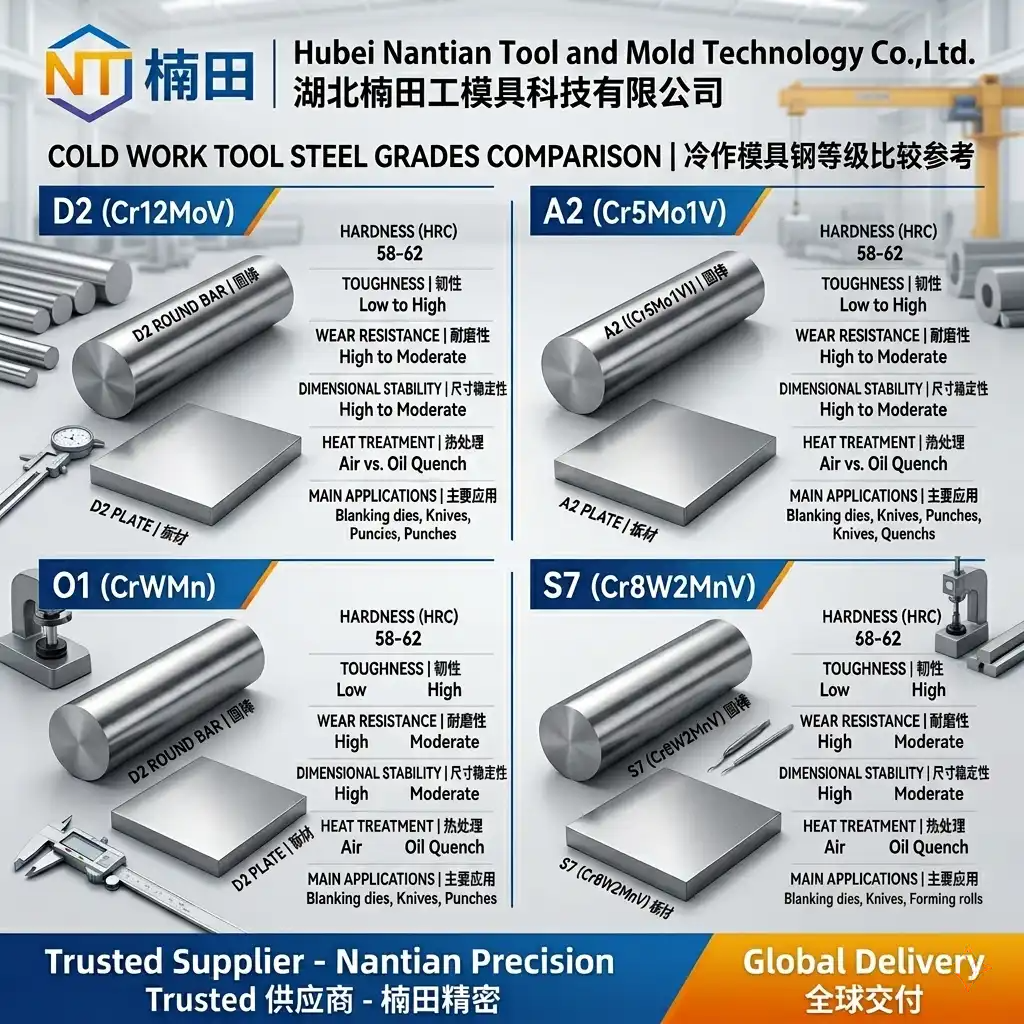
Most toolroom grade selection problems start the same way: a die fails earlier than expected, someone suggests switching steel, and suddenly you're comparing four grades with overlapping descriptions — "good wear resistance," "good toughness," "air hardening" — without a clear framework for deciding which property matters most in your specific application.
Then a European supplier quotes you 1.2379 for what your drawing calls D2. A Japanese source offers SKD11. A Chinese mill lists Cr12Mo1V1. Same steel? Mostly. But the minor chemistry differences between national standards, and the absence of a clean cross-reference in most sourcing conversations create uncertainty that slows decisions and occasionally leads to wrong material selection.
This guide covers the full AISI cold work tool steel classification system — D-series, A-series, O-series, and S-series — with DIN/EN Werkstoff equivalents, JIS equivalents, and practical selection criteria for each grade family. It's designed as a reference document for die engineers and toolroom procurement managers who need to make grade decisions with confidence, regardless of which country their steel is sourced from.
Written by the export team at Nantian (Hubei Nantian Tool and Mold Technology Co., Ltd.), an integrated cold work tool steel manufacturer in Huangshi, Hubei, China. We produce and export D2/1.2379, A2/1.2363, O1/1.2510, and related grades to toolrooms and distributors across North America, Europe, and Asia. Annual capacity: 300,000 tons.
Table of Contents
How AISI Classifies Cold Work Tool Steel: The Letter-Number System Explained
D-Series: High-Carbon, High-Chromium Grades (D2, D3, D4, D5, D6, D7)
A-Series: Air-Hardening, Medium-Alloy Grades (A2, A6, A8, A9, A10)
How AISI Classifies Cold Work Tool Steel: The Letter-Number System Explained
The AISI (American Iron and Steel Institute) tool steel classification system organizes grades by their primary alloying characteristic or intended application, using a letter prefix followed by a number that distinguishes grades within the same family. For cold work tool steels, the relevant prefixes are D (high-carbon, high-chromium), A (air-hardening, medium-alloy), O (oil-hardening), and S (shock-resisting).
The system is defined in ASTM A681, the standard specification for alloy tool steels. [外链建议:ASTM A681 alloy tool steel specification → astm.org — nofollow noopener] The letter does not describe a single property — it describes a primary design philosophy. "D" grades are built around maximum carbide volume for maximum wear resistance. "A" grades sacrifice some wear resistance for better toughness and dimensional stability. "O" and "S" grades move further toward toughness at the expense of the wear resistance that defines the D family.
How Does the AISI System Compare to DIN and JIS Classification?
DIN/EN (European) and JIS (Japanese) systems classify tool steels by chemistry notation rather than application family. DIN uses Werkstoff numbers (e.g., 1.2379) alongside a compositional abbreviation (X155CrVMo12-1 — reading as "155 hundredths percent C, 12% Cr, 1% Mo, with V"). JIS uses an "SK" or "SKD" prefix (S = steel, K = tool, D = die) followed by a number.
Chinese GB/T standard uses a composition-based naming convention similar to DIN — Cr12Mo1V1 directly encodes the main alloying elements. In practice, all four systems contain grades that are metallurgically near-identical, with minor differences in element tolerance limits that are rarely significant for most tooling applications. The cross-reference table in Section 6 maps the major equivalents explicitly.
D = High-carbon, high-chromium. Maximum wear resistance. Lower toughness.
A = Air-hardening, medium-alloy. Balanced wear + toughness. Good dimensional stability.
O = Oil-hardening. Good toughness, moderate wear. Lower alloy cost.
S = Shock-resisting. Maximum toughness. Not for abrasive wear applications.
D-Series: High-Carbon, High-Chromium Grades (D2, D3, D4, D5, D6, D7)
The D-series represents the highest wear resistance tier in the AISI cold work system — achieved through carbon levels from 1.40% to 2.35% and chromium from 11% to 13%, producing large volumes of hard chromium carbides (Cr₇C₃, Cr₂₃C₆) distributed through a martensitic matrix. All D-series grades are air-hardening, which gives them minimal quench distortion compared to oil or water-hardening alternatives.
D2 — The Industry Standard High-Chromium Grade
D2 (DIN 1.2379 / X155CrVMo12-1 / JIS SKD11 / GB Cr12Mo1V1) is the most widely used grade in the D-series — and arguably the most widely used cold work tool steel globally. Carbon: 1.40–1.60%. Chromium: 11.0–13.0%. Molybdenum: 0.70–1.20%. Vanadium: 0.50–1.10%.
It air-hardens to 60–62 HRC and offers the best combination of wear resistance and machinability within the D-series. That combination is why it dominates blanking dies, forming dies, slitting cutters, drawing dies, and thread rolling dies across North American and European automotive and electronics manufacturing.
Its limitation — toughness. The high carbide volume makes D2 prone to chipping in applications with sharp re-entrant angles, thin sections, or significant impact loading. For those cases, the A-series (particularly A2) is the standard alternative.
D3 — Maximum Wear, Minimum Toughness
D3 (DIN 1.2080 / X210Cr12 / JIS SKD1 / GB Cr12) pushes carbon to 2.00–2.35% while removing molybdenum entirely. The result: a higher carbide volume fraction than D2 and correspondingly higher wear resistance — but significantly lower toughness.
D3 is oil-hardening, which separates it from the rest of the D-series. That means higher distortion risk during heat treatment. It's used for wear plates, blanking punches with simple geometry running very long production cycles, and powder compaction tooling where the loading is predominantly compressive. Not for anything with thin sections or bending stress.
Worth mentioning: D3 is sometimes used interchangeably with D2 in specifications that just call for "high-chromium tool steel" without specifying grade. They are not interchangeable — D3's lower toughness and oil-hardening requirement make it a meaningfully different specification choice.
D4, D5, D6 — Specialty High-Chromium Variants
These three grades are less commonly stocked but serve specific needs:
D4: Similar to D3 in carbon but with added molybdenum (0.70–1.20%) — air-hardening like D2 but with D3-level wear resistance. Less common in North America; appears more frequently in European and Asian tool steel catalogs.
D5: D2 chemistry plus 3% cobalt. Cobalt raises red hardness and tempering resistance — making D5 the only D-series grade suitable for applications where die temperatures approach 400–450°C. Rare in standard toolroom use; specified mainly for hot-trimming operations or where die heating is a documented issue.
D6: High carbon (2.00–2.35%) plus tungsten (1.00%) — combines D3-level wear resistance with better toughness than D3 through tungsten's grain refinement effect. Used in cutting tools and broaching applications more than die work.
D7 — The Extreme Wear Grade
D7 is the maximum wear resistance grade in the AISI system: 2.15–2.50% carbon, 11.5–13.5% chromium, 3.8–4.4% vanadium. The high vanadium content forms very hard MC vanadium carbides that provide exceptional abrasion resistance against hard particles — making D7 the choice for drawing dies processing highly abrasive materials, or wear components in mineral processing equipment.
Toughness is very low. Machining and grinding are difficult. D7 is a specialist grade, not a general-purpose cold work steel — most North American toolrooms will encounter it rarely, if ever.
| Grade | C % | Cr % | Other Key Elements | Hardening | HRC Range | Primary Use |
|---|---|---|---|---|---|---|
| D2 | 1.40–1.60 | 11.0–13.0 | Mo 0.70–1.20, V 0.50–1.10 | Air | 60–62 | Blanking, forming, slitting dies |
| D3 | 2.00–2.35 | 11.0–13.5 | — | Oil | 58–62 | Wear plates, simple blanking punches |
| D4 | 2.05–2.40 | 11.0–13.0 | Mo 0.70–1.20 | Air | 58–62 | High wear + air-hardening requirement |
| D5 | 1.40–1.60 | 11.0–13.0 | Co 2.50–3.50, Mo 0.70–1.20 | Air | 60–62 | Hot-trimming, elevated-temp die work |
| D7 | 2.15–2.50 | 11.5–13.5 | V 3.80–4.40, Mo 0.70–1.20 | Air | 60–65 | Extreme abrasion, drawing dies |
A-Series: Air-Hardening, Medium-Alloy Grades (A2, A6, A8, A9, A10)
The A-series fills the gap between D-series (maximum wear, lower toughness) and O-series (better toughness, oil quench required) — delivering moderate wear resistance, better toughness than D2, and the dimensional stability advantage of air hardening. For die applications where D2 chips or cracks but O1 wears too fast, the A-series — particularly A2 — is the standard solution.
A2 — The Balanced Cold Work Workhorse
A2 (DIN 1.2363 / X100CrMoV5-1 / JIS SKD12 / GB Cr5Mo1V) is the most widely used A-series grade. Carbon: 0.95–1.05%. Chromium: 4.75–5.50%. Molybdenum: 0.90–1.40%. Vanadium: 0.15–0.50%.
At 57–62 HRC after heat treatment, A2 gives you: substantially better toughness than D2 (approximately 1.5–2× in Charpy testing at equivalent hardness); lower carbide volume — meaning fewer and finer carbides, less prone to the banding failures that affect D2 in large sections; and true air hardening with dimensional change of roughly ±0.05% — one of the most stable of any tool steel grade during heat treatment.
A2 is the go-to grade for: complex die geometry with thin features where D2 chips; trimming and forming dies where some shock loading accompanies the press stroke; punches and bushings where tight dimensional control post-heat-treatment is critical; and gauges and precision tools where surface finish and grindability matter.
Its limitation relative to D2: wear resistance is lower. A2 running against abrasive materials will wear faster than D2. For high-volume blanking on stainless or abrasive coated sheet, D2 typically outlasts A2 on a per-cycle basis — assuming chipping isn't the failure mode.
A6 — Lower Austenitizing Temperature Variant
A6 (no direct DIN equivalent — closest is 1.2419 / 105WCr6) is an air-hardening grade with a lower austenitizing temperature (around 845°C versus 925–980°C for A2). That lower heat treat temperature means less distortion and better size control for thin or complex sections. Carbon: 0.65–0.75%. Chromium: 0.90–1.20%. Manganese: 1.80–2.50%.
A6 is less common than A2 in North American toolrooms but appears in applications where heat treatment distortion control is the primary driver — surgical instruments, precision gauges, and small intricate die components where the difference between 900°C and 845°C austenitizing translates to measurable dimensional change.
A8, A9, A10 — Specialty Air-Hardening Grades
A8: Carbon 0.50–0.60%, with tungsten and molybdenum additions. Lower hardness ceiling (~56–58 HRC) but the highest toughness of the A-series. Used for chisels, punches, and heavy-impact dies where toughness dominates. Sits at the boundary between cold and warm work applications.
A9: Similar to A8 but with cobalt addition for better high-temperature performance. Niche application — aluminum die-casting trimming operations where the die sees intermittent elevated temperature exposure.
A10: Manganese-based air-hardening grade with graphite additions. The graphite improves machinability and provides some self-lubricating behavior. Used in draw dies and forming tools where galling resistance matters alongside wear resistance. Rarely encountered in standard toolroom practice.
| Grade | C % | Cr % | Other Key Elements | HRC Range | vs D2 Toughness | Primary Advantage |
|---|---|---|---|---|---|---|
| A2 | 0.95–1.05 | 4.75–5.50 | Mo 0.90–1.40, V 0.15–0.50 | 57–62 | ~1.5–2× | Best balance: air-hardening stability + improved toughness |
| A6 | 0.65–0.75 | 0.90–1.20 | Mn 1.80–2.50, Mo 1.25–1.75 | 54–60 | ~2× | Lowest HT temperature in A-series — minimal distortion |
| A8 | 0.50–0.60 | 4.75–5.50 | W 1.00–1.50, Mo 1.15–1.65 | 54–58 | ~3–4× | Highest toughness in A-series; heavy impact applications |
O-Series: Oil-Hardening Grades (O1, O2, O6, O7)
O-series grades are oil-hardening cold work steels characterized by lower alloy content, lower cost, and good toughness — at the expense of the dimensional stability that air-hardening grades provide. The oil quench required for hardening introduces more dimensional change than gas or air cooling, which limits O-series use to applications where post-heat-treatment grinding or machining can correct any distortion.
O1 — The Most Versatile General-Purpose Cold Work Steel
O1 (DIN 1.2510 / 100MnCrW4 / JIS SKS3 / GB 9CrWMn) is the simplest and most forgiving cold work tool steel in the AISI system. Carbon: 0.85–1.00%. Chromium: 0.40–0.60%. Tungsten: 0.40–0.60%. Manganese: 1.00–1.40%.
O1 oil-hardens to 57–62 HRC. It machines exceptionally well in the annealed condition — its lower alloy content means less tool wear during pre-hardening roughing than D2 or A2. It holds sharp edges well after hardening and resists tempering softening at low service temperatures.
Typical applications: cutting tools (end mills, taps, reamers — though HSS has largely displaced O1 in cutting tools), gauges, low-volume forming dies, threading tools, broaches, short-run punches, and precision tools where the economics of simpler steel justify the post-HT grinding step.
O1 is not the choice for high-volume blanking. Its carbide volume is much lower than D2, and it will wear significantly faster against abrasive workpiece materials. It's also more prone to dimensional change during heat treatment than A2 — which means it needs more grinding stock left on finished surfaces before quench.
O2 — High-Manganese Variant for Better Hardenability
O2 (DIN 1.2842 / 90MnCrV8 / JIS SKS31) substitutes higher manganese (1.40–1.80%) for O1's tungsten and chromium, improving hardenability in larger sections while maintaining similar toughness. Carbon: 0.85–0.95%.
O2 is the preferred O-series grade in Europe (where it's more commonly stocked than O1 in the DIN system). In North America, O1 dominates. The practical performance difference between O1 and O2 is minor for most toolroom applications — section size and hardenability are the deciding factor when one is preferred over the other.
O6 — Graphitic Oil-Hardening Grade
O6 is an unusual grade — it contains free graphite in its microstructure (graphitic tool steel), which provides self-lubricating behavior and excellent machinability. Carbon: 1.25–1.55%. Silicon: 0.55–1.50% (silicon promotes graphite formation during annealing).
O6 is specified where galling or seizing between steel die surfaces is a problem — deep-drawing dies, aluminum extrusion dies, and forming tools for soft metals. Not a mainstream grade in most North American toolrooms, but worth knowing when a specific application problem involves adhesive wear or galling rather than abrasive wear.
S-Series: Shock-Resisting Grades (S1, S5, S7)
S-series grades are engineered specifically for impact loading — applications where the primary failure mode is fracture or chipping from sudden high-energy blows rather than gradual abrasive wear. They achieve this through low-to-medium carbon content (0.45–0.65%), which produces lower carbide volume and correspondingly higher toughness than any other cold work family — at the cost of wear resistance that is far below D-series or even O-series grades.
S1 — Tungsten-Based Shock Grade
S1 (DIN 1.2542 / 45WCrV7 / JIS —) uses tungsten (2.00–3.00%) and chromium (1.00–1.80%) with moderate carbon (0.40–0.55%) to produce a tough, impact-resistant steel that also tolerates moderate elevated temperatures — making it one of the few cold work grades that can survive intermittent heating to 400–450°C without severe softening. Used for hot punches, cold chisels, and hammer tooling.
S5 — Manganese-Silicon Shock Grade
S5 (no direct DIN equivalent) replaces S1's tungsten with silicon (1.75–2.25%) and manganese (0.60–1.00%) to achieve similar toughness at lower cost. Carbon: 0.50–0.65%. Used for pneumatic tool parts, chisels, rivet sets, and heavy-duty punching equipment where the tungsten addition in S1 is cost-prohibitive.
S7 — Air-Hardening Shock Grade
S7 (DIN 1.2357 approximate / no direct JIS equivalent) is the most widely used S-series grade in North America — primarily because it is air-hardening, unlike S1 and S5, which require oil quenching. Carbon: 0.45–0.55%. Chromium: 3.00–3.50%. Molybdenum: 1.30–1.80%.
At 54–58 HRC, S7 provides excellent impact resistance, good machinability, and minimal distortion during heat treatment. It's used for stripper bolts, heavy forming punches, coining dies running under high tonnage, and hot-to-cold trimming operations. The air-hardening characteristic makes it practical for complex shaped tooling where oil quench distortion would be problematic.
One thing I always clarify for engineers encountering S-series for the first time: if your die is failing by wear, S7 is the wrong answer. Its wear resistance is low — roughly comparable to a normalized medium-carbon steel. S-series is exclusively for impact-dominated failure modes.
Complete Cross-Reference Table: AISI ↔ DIN/EN ↔ JIS ↔ GB
The table below provides the most comprehensive cross-reference available for cold work tool steel grade equivalents across the four major standards systems. Note that "equivalent" means metallurgically similar — chemistry tolerances differ slightly between standards, and mechanical property requirements are not always identical. Verify chemistry against the specific standard cited on your supplier's MTC before assuming full interchangeability on a tight specification.
| AISI Grade | DIN Werkstoff No. | DIN/EN Name | JIS (Japan) | GB (China) | Notes |
|---|---|---|---|---|---|
| D2 | 1.2379 | X155CrVMo12-1 | SKD11 | Cr12Mo1V1 | Most widely traded cold work grade globally. Minor V/Si limits differ between ASTM and DIN versions. |
| D3 | 1.2080 | X210Cr12 | SKD1 | Cr12 | ASTM D3 is oil-hardening; DIN 1.2080 is also oil-hardening. High carbide volume, low toughness. |
| D4 | 1.2083 (approx.) | X42Cr13 | — | 4Cr13 | DIN 1.2083 differs — primarily a plastic mold steel, not exact D4 equivalent. No close JIS match. |
| D5 | 1.2379 + Co (special) | — | SKD11 + Co | — | No standard DIN/JIS equivalent — D5 is a US-market specialty grade. |
| D7 | 1.2379 + V (special) | — | SKD11 + V | — | No standard DIN/JIS equivalent. High V content distinguishes from D2. |
| A2 | 1.2363 | X100CrMoV5-1 | SKD12 | Cr5Mo1V | Good equivalency across all four systems. Most balanced cold work grade after D2. |
| A6 | 1.2419 (approx.) | 105WCr6 | — | — | DIN 1.2419 is not exact — different alloy system. No JIS equivalent. |
| A8 | 1.2606 (approx.) | — | — | — | No close DIN/JIS equivalent. A8 is a US-specific grade designation. |
| O1 | 1.2510 | 100MnCrW4 | SKS3 | 9CrWMn | Good equivalency. O1 = North American standard; 1.2510 = European standard for same alloy class. |
| O2 | 1.2842 | 90MnCrV8 | SKS31 | 9Mn2V | European toolrooms commonly specify 1.2842 where North American specs call O1 or O2. Slightly different Mn/W balance. |
| O6 | — | — | — | — | Graphitic grade — no direct DIN/JIS equivalent. US-specific designation. |
| S1 | 1.2542 | 45WCrV7 | — | 4CrW2Si | Reasonable equivalency. S1 chemistry differs slightly from 1.2542 in Si/Mn content. |
| S5 | 1.2605 (approx.) | — | — | 5CrMnSiMoV (approx.) | No close DIN equivalent. S5's high Si content is unusual in DIN system. |
| S7 | 1.2357 (approx.) | — | — | — | No standard DIN or JIS equivalent. S7's air-hardening, shock-resisting combination is primarily North American. |
A practical note on using this table: the "approx." entries mean there is a metallurgically related grade in that standard system, but the chemistry tolerances or classification logic don't fully align. For those entries, always verify the actual composition on the MTC against your drawing specification — don't assume interchangeability from grade designation alone.
Grade Selection Framework: Matching Steel to Failure Mode
The single most useful question in cold work tool steel selection is: how does this die fail? Not "what hardness do I need?" or "what's the cheapest grade?" — those questions lead to catalog browsing. Failure mode analysis leads to grade families that actually solve the problem.
| Failure Mode | Recommended Grade Family | Best Starting Grade | When to Move Up/Down |
|---|---|---|---|
| Abrasive wear — die wears out gradually, edge radius increases over production run | D-series | D2 / 1.2379 | Move to D7 if D2 still wears too fast. Move to A2 if chipping accompanies wear. |
| Edge chipping — small chips at cutting edge or sharp features, typically early in run | A-series (or DC53) | A2 / 1.2363 or DC53 | Move to A8 or S7 if chipping continues. Check heat treatment parameters before switching — under-tempered D2 chips heavily. |
| Gross fracture — die breaks catastrophically, usually on a press overload or setup error | S-series | S7 (air-hardening) | S1 if elevated temperature exposure present. Confirm fracture is steel-related, not tooling design or setup issue first. |
| Galling / adhesive wear — material transfer from workpiece to die surface | O-series (O6) or surface treatment | O6 or PVD-coated D2 | Consider surface treatment (TiN, TiAlN) on D2 before switching to O6 — coating is usually more effective than grade change. |
| Heat checking / thermal fatigue — surface cracks from thermal cycling (warm work boundary) | D5 (if minor) or hot work grades | D5 or H13 | If die temperature regularly exceeds 250°C, the application is warm/hot work — cold work grades are not appropriate. |
| Dimensional distortion after HT — die geometry changes during hardening, scrap on first grind | A-series (air-hardening) | A2 / 1.2363 | A6 for extreme distortion sensitivity. D2 (also air-hardening) if wear resistance must be maintained. |
One pattern I've seen repeatedly: engineers switch from D2 to A2 after a chipping failure, get better results, then over-apply A2 to applications where D2's wear resistance was actually the right call — and end up with dies that perform well initially but wear out in half the expected cycles. Grade selection is not a one-direction optimization. Both over-engineering toughness and under-engineering it cost you regrind cycles and downtime.
Heat Treatment Quick Reference Across Grade Families
The table below summarizes the critical heat treatment parameters for each grade family. These are reference ranges — your heat treater's specific equipment, load size, and atmosphere will affect the exact parameters. Always cross-reference against the specific grade's material data sheet and ASTM A681 for final specification.
| Grade Family | Representative Grade | Austenitizing Temp (°C) | Quench Medium | Tempering Range (°C) | As-Hardened HRC | Key HT Note |
|---|---|---|---|---|---|---|
| D-series | D2 / 1.2379 | 1000–1040 | Air / inert gas | 180–200 (max hardness) or 525±5 (secondary hardening) | 62–64 | Avoid 300–400°C temper range — tempered martensite embrittlement trough |
| D-series | D3 / 1.2080 | 925–980 | Oil | 150–230 | 60–64 | Oil quench required — higher distortion than air-hardening D grades |
| A-series | A2 / 1.2363 | 925–980 | Air | 175–540 | 60–62 | Most dimensionally stable air-hardening grade — ±0.05% typical change |
| A-series | A6 | 830–870 | Air | 150–370 | 57–61 | Lowest austenitizing temp in A-series — minimum distortion |
| O-series | O1 / 1.2510 | 790–830 | Oil | 175–260 | 60–64 | Simplest steel to heat treat; excellent as-quenched hardness response |
| O-series | O2 / 1.2842 | 760–800 | Oil | 175–260 | 60–63 | Lower austenitizing than O1 — marginally better size control |
| S-series | S7 | 925–955 | Air | 175–620 | 56–58 | Wide tempering range — adjust hardness to impact vs. wear balance for application |
| S-series | S1 / 1.2542 | 900–955 | Oil | 200–650 | 50–58 | Can be tempered high (650°C) for maximum toughness; retains hardness to ~400°C service temp |
Quick note on double tempering: all D-series and most A-series grades should receive at minimum two temper cycles after quenching. The first temper converts as-quenched martensite; the second tempers the fresh martensite formed from any retained austenite that transformed during the first temper cooldown. Single temper on D2 or A2 is a documented cause of below-specification toughness — not a theoretical risk.
Sourcing Cold Work Tool Steel: What to Ask Any Supplier
Grade knowledge only gets you halfway to a successful cold work steel purchase. The other half is supplier qualification — specifically, understanding whether the steel you're buying was actually produced to the grade standard, or just labeled to it.
Three questions that separate integrated mills from trading companies on any grade in this guide:
Can you show me the original mill MTC with actual chemistry values — not a "conforms" stamp? An EN 10204 Type 3.1 certificate with element-by-element measured values (C, Cr, Mo, V, Si, Mn, P, S) is the minimum standard for die-grade tool steel. If the supplier provides a retyped certificate without a mill stamp or heat number, you're buying their word, not the steel's data.
What UT standard was used, and what acceptance class did this material achieve? Ultrasonic testing per SEP1921 is the European industry standard for tool steel. If a supplier says "we do UT" but can't specify the class achieved, the test result has no contractual meaning.
Was this material forged before rolling? For sections above 60–80mm, forging reduction before rolling is critical for breaking up the as-cast carbide network. Rolling-only mills cannot provide adequate forging reduction at these section sizes — and the result is carbide banding that won't show up on a chemistry test but will cause premature fracture in service.
Nantian produces D2 (1.2379), A2 (1.2363), O1 (1.2510), and related cold work grades from our integrated Huangshi facility — electric arc furnace through rolling, forging, nitrogen-atmosphere annealing, six-stage inspection, and QR-coded traceability on every piece. We supply round bars (φ12–360mm) and plates (1–360mm thick, 30–1020mm wide) with EN 10204 Type 3.1 MTCs as standard.
If you're at the grade selection stage and want a second opinion on which cold work steel fits a specific application, our engineering team is available to review your die drawing and failure mode description. No commitment required. → Submit a grade selection inquiry | hbntkj@nantiansteel.com | WhatsApp: +8618007237687
Frequently Asked Questions
What is the difference between D2, A2, and O1 tool steel?
D2 (1.2379) is a high-carbon, high-chromium grade (1.40–1.60% C, 11–13% Cr) offering maximum wear resistance — ideal for high-volume blanking and forming. A2 (1.2363) has lower carbon and chromium (1.0% C, 5% Cr), providing better toughness and dimensional stability in heat treatment — best for complex die geometry or where D2 chips. O1 (1.2510) is oil-hardening with lower alloy content, offering excellent machinability and good toughness for lower-volume applications and gauges.
What does the letter prefix mean in AISI tool steel grade designations?
The letter describes the primary design philosophy: D = high-carbon, high-chromium (maximum wear resistance); A = air-hardening, medium-alloy (balanced wear and toughness); O = oil-hardening (good toughness, lower cost); S = shock-resisting (maximum toughness, minimum wear resistance). All four are classified under ASTM A681.
What is the DIN equivalent of AISI D2 tool steel?
AISI D2 is equivalent to DIN 1.2379 (X155CrVMo12-1) under DIN EN ISO 4957. The Japanese equivalent is JIS SKD11, and the Chinese GB equivalent is Cr12Mo1V1. Minor chemistry tolerance differences exist between standards — verify actual composition on the MTC for tight specifications.
Is D2 always better than A2 for cold work dies?
Not exactly. D2 is better when wear is the primary failure mode. A2 is better when chipping, cracking, or heat treatment distortion is the failure mode. A2 provides approximately 1.5–2× higher toughness than D2 at equivalent hardness. The right grade depends on your specific failure mode, die geometry, and workpiece material — not on a general "better" ranking.
What is S7 tool steel used for?
S7 is an air-hardening shock-resisting grade (0.45–0.55% C, 3.0–3.5% Cr, 1.3–1.8% Mo) used for impact tooling — heavy punches, coining dies, stripper bolts, and applications where catastrophic fracture is the failure mode rather than gradual wear. It air-hardens to 54–58 HRC and has the best toughness of any air-hardening cold work steel in the AISI system.
Can I substitute O1 for D2 in a blanking die?
Not without significant performance impact. O1's carbide volume is far lower than D2 — it will wear substantially faster in abrasive blanking applications. O1 is suited for low-to-medium volume dies, gauges, and precision tools where machinability and toughness matter more than long-run wear life. For high-volume blanking of steel sheet, D2 (or A2 if toughness is needed) is the appropriate grade family.
What is DC53 and how does it relate to the AISI classification system?
DC53 is a modified cold work steel developed by Daido Steel (Japan) — it is not an AISI-classified grade. It sits between D2 and A2 in chemistry and performance: higher toughness than D2 through lower carbon (~1.0%) and chromium (~8%), but higher hardness ceiling than A2 (62–64 HRC with high-temperature tempering). It does not have an official DIN Werkstoff number, though it is imported and used in European toolrooms under the DC53 brand designation.
How do I know which cold work steel grade to specify for a new die program?
Start with your expected failure mode based on similar applications or toolroom experience. Wear-dominated → D-series (start with D2). Chipping-dominated → A-series (start with A2) or DC53. Impact/fracture-dominated → S-series (start with S7). If you have no prior data, A2 is the most forgiving starting point — its balanced properties rarely produce catastrophic failures, and its performance data will help you optimize grade selection for subsequent die programs.
The Practical Summary: Four Families, One Rule
The AISI cold work tool steel system contains more grades than any toolroom will ever need to use regularly. In practice, most North American toolrooms work with a rotation of three to five grades that cover 90% of their applications:
D2 / 1.2379 — default choice for high-volume blanking and forming where wear is the failure mode
A2 / 1.2363 — go-to when D2 chips, or when dimensional stability through heat treatment is critical
O1 / 1.2510 — for gauges, low-volume tooling, and applications where machinability and cost matter more than long wear life
S7 — for genuine impact applications where fracture, not wear, is the failure mode
DC53 or ESR-grade D2 — for complex precision dies where standard D2 delivers inconsistent life due to carbide banding, or where wire-EDM residual stress is a documented issue
The cross-reference table in Section 6 covers the full DIN/JIS/GB equivalents for sourcing these grades internationally. The one rule worth repeating: always verify actual chemistry values on the MTC against the standard your drawing specifies. Grade designation equivalency is a starting point, not a guarantee of interchangeability on tight specifications.
→
Get a technical consultation or grade-specific
quote from Nantian
hbntkj@nantiansteel.com
| WhatsApp: +8618007237687
About the Author
Ajiao Liu is Export Manager at Hubei Nantian Tool and Mold Technology Co., Ltd., Huangshi, Hubei, China — an integrated cold work tool steel manufacturer producing D2/1.2379, A2/1.2363, O1/1.2510, and related grades on five forging and rolling lines with Austrian GFM radial forging and INTECO ESR systems. She works with toolrooms and steel distributors across North America, Europe, Southeast Asia, and the Middle East. Contact: hbntkj@nantiansteel.com | +8618007237687.