

By Ajiao Liu | Nantian Steel Export Team | Updated May 2026
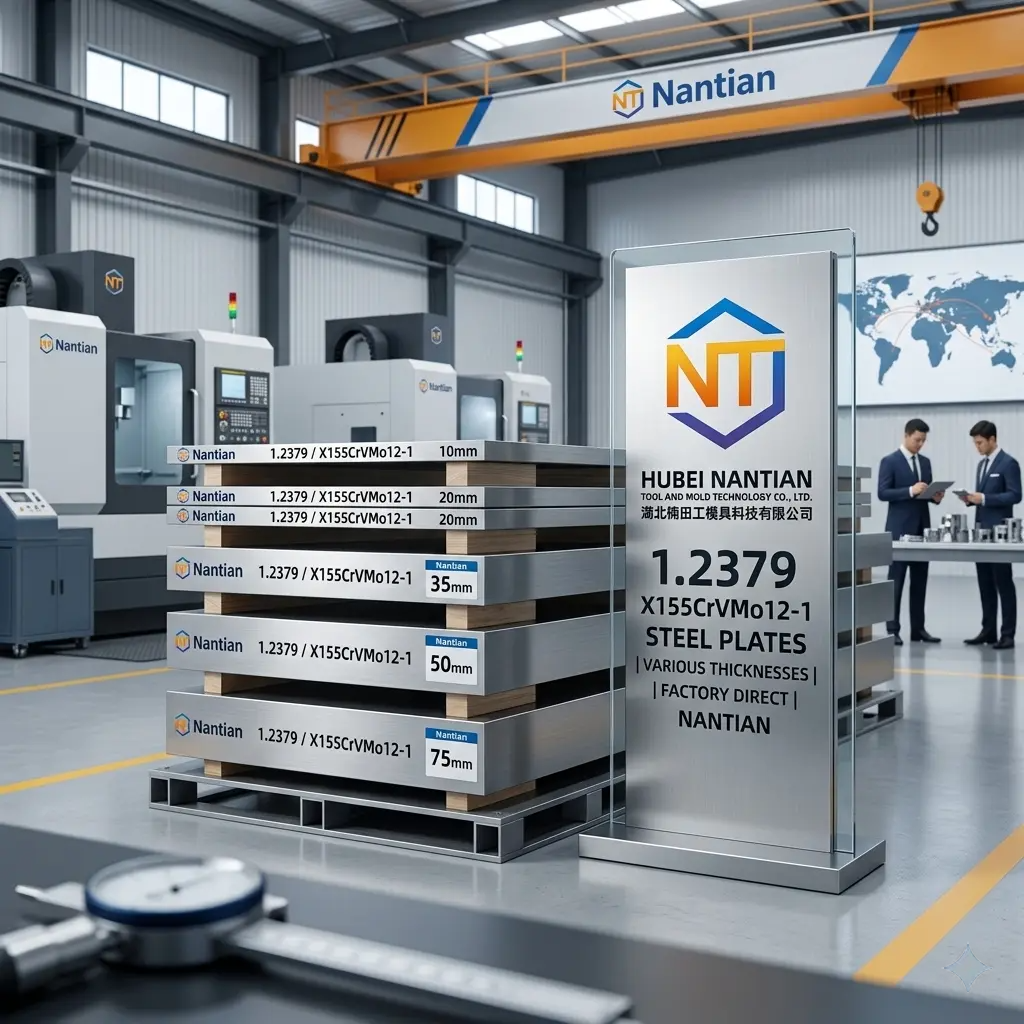
European tool and die procurement managers face a recurring problem with 1.2379 plate supply: standard-stocking distributors carry a narrow size window — typically 10–150mm thick, 250–630mm wide — and anything outside that range means a special order, a six-week wait, and a price that reflects the inconvenience. Meanwhile, your die program needs 280mm-thick blocks at 820mm width, or 3mm precision-ground blanks at 400mm width, or both in the same delivery.
That mismatch costs toolrooms more than the price premium suggests. Delayed material holds up CNC scheduling, forces buffer stock on standard sizes, and compresses the heat treatment window before a customer deadline.
Nantian produces 1.2379 (X155CrVMo12-1 / D2 / SKD11 / Cr12Mo1V1) plates and flat bars from 1mm to 360mm thick and 30mm to 1020mm wide — in a single integrated facility in Huangshi, Hubei, China. We roll, forge, anneal, inspect, and cut to your specification. No intermediary mill. No size surcharge beyond the cost of production.
Written by Nantian's export team. We have shipped 1.2379 plates to toolrooms and steel distributors in Germany, Italy, Poland, Turkey, and across Central and Eastern Europe since our rolling lines reached full capacity. Annual output: 300,000 tons across all grades.
Table of Contents
What Is 1.2379 / X155CrVMo12-1 Steel Plate? Grade Reference and Equivalents
Full Size Range: Thickness, Width, and Custom Cutting Options
How Nantian Produces 1.2379 Plate: Rolling, Forging, and Annealing
Documentation for European Import: MTC, EN 10204, and QR Traceability
Ordering for European Delivery: MOQ, Lead Time, Incoterms, and Port Routing
What Is 1.2379 / X155CrVMo12-1 Steel Plate? Grade Reference and Equivalents
1.2379 is the German DIN Werkstoff number designation for a high-carbon, high-chromium cold work tool steel formally specified as X155CrVMo12-1 under DIN EN ISO 4957. It is equivalent to AISI D2 (USA), SKD11 (Japan, JIS G4404), and Cr12Mo1V1 (China, GB/T 1299). In European engineering and procurement documentation, 1.2379 is the standard designation — X155CrVMo12-1 appears on material certificates and drawing callouts, D2 appears in non-European supplier quotations for the same grade.
The "plate" or "Stahlplatte" form covers flat-rolled and forged-then-sawn products supplied in the annealed condition, ready for machining, EDM, and subsequent heat treatment by the toolroom. It is the most commonly purchased form factor for die block applications — as opposed to round bars, which are used for punch and pin stock.
What Are the Key Chemical Composition Limits for 1.2379?
| Element | DIN EN ISO 4957 Range | Function |
|---|---|---|
| Carbon (C) | 1.40–1.60 % | Forms carbide volume fraction; primary driver of wear resistance |
| Chromium (Cr) | 11.00–13.00 % | Forms Cr₇C₃ and Cr₂₃C₆ carbides; contributes to hardenability and corrosion resistance |
| Molybdenum (Mo) | 0.70–1.20 % | Improves hardenability at depth; secondary hardening response |
| Vanadium (V) | 0.50–1.10 % | Forms hard MC carbides; grain refinement and wear resistance |
| Silicon (Si) | 0.10–0.60 % | Deoxidation; minor contribution to hardness |
| Manganese (Mn) | 0.20–0.60 % | Hardenability; deoxidation |
Every plate we ship is verified against these composition limits using a German mobile spectrometer before it advances to rolling. If a heat misses the target window on any element, it doesn't proceed — regardless of how close it is. That's not a flexible standard in our QC system.
Full Size Range: Thickness, Width, and Custom Cutting Options
Nantian's 1.2379 plate production covers thickness from 1mm to 360mm and width from 30mm to 1020mm — the broadest size window available from a single-source integrated mill for this grade. Most European stocking distributors operate a much narrower commercial range. Understanding where those gaps are helps procurement managers decide when a direct mill order saves time and money versus when local stock makes more sense.
How Does Thickness Range Affect Which Production Route Is Used?
Thin to medium plates (1–80mm thick) come off our 950, 750, or 650 hot rolling lines. These produce the most consistent surface flatness and dimensional tolerance — suitable for applications where the plate will be used near net shape after surface grinding, or where tight thickness tolerance is specified in the contract.
Heavy plates and die blocks (80–360mm thick) are produced via our 3,000-ton precision forging press, then sawn or cut to width. The forging press gives these sections their internal density — forging reduction at this scale breaks up the as-cast carbide network that would otherwise persist in thick sections and create the banding structures we discussed in the D2 vs DC53 comparison.
Width coverage up to 1020mm is enabled by our 950 rolling line's 1050mm roller width and 950mm roller diameter. That combination optimizes the reduction ratio and lets us roll wider flats than most Chinese mills can achieve on this grade. For widths above 700mm, flag it at inquiry — we'll confirm the specific rolling pass available for your thickness-width combination.
What Custom Cutting Options Are Available?
We supply 1.2379 plate in the following forms:
As-rolled / as-forged plates — full-width slab, customer saws to final die block size
Sawn-to-length — cut to your specified length ± sawing tolerance; standard for die block orders
Sawn-to-width strips — longitudinal ripping to narrow widths from wider rolled plate; useful for progressive die punch stock
Custom thickness + width combinations — specified at order; production scheduled to your dimension rather than standard catalog size
Fair question: is there a size surcharge? For non-standard dimensions, the answer depends on the rolling pass required. Some width-thickness combinations sit naturally on an existing production schedule — no premium. Others require a dedicated pass setup — we'll tell you at quotation stage exactly what that adds in lead time and cost. No surprises after order placement.
How Nantian Produces 1.2379 Plate: Rolling, Forging, and Annealing
The production route for 1.2379 plate at Nantian runs from electric arc furnace to finished, inspected plate without leaving our facility. That single-site integration is what allows us to offer the full size range above — and to guarantee that every plate in your order originated from the same controlled production process, not from opportunistic buying across multiple mills.
Steelmaking: Locking in the Chemistry Before the First Rolling Pass
The sequence: electric arc furnace (EAF) → ladle refining furnace (LF) → vacuum degassing (VD). The VD step removes dissolved hydrogen (target H₂ ≤ 2 ppm for standard grade), reduces oxygen and nitrogen to minimize porosity and inclusion formation, and allows final composition trimming before casting. Chemistry is sampled and spectrometer-verified at tap — before the heat is released to the forging or rolling schedule.
For ESR-grade 1.2379 plates, the cast ingot proceeds to our INTECO atmosphere-protection remelting furnace (8-ton or 16-ton unit) before forging. The result is a measurably cleaner ingot — non-metallic inclusions reduced by 40–60% versus conventional arc melt, carbide size refined to 3–8µm versus the 8–18µm typical of standard production. I'll cover when ESR is worth specifying in Section 6.
Rolling and Forging: Where Flatness and Density Are Built
Thin and medium plates go through the 950 hot rolling line. Our high-pressure water descaling (followed by high-pressure wind drying) runs before each rolling pass — removing oxide scale that would otherwise be rolled into the surface and create embedded inclusions detectable in downstream machining. The 1050mm roller width enables coverage of your full 1020mm width spec with a single-pass roll, rather than requiring multiple off-center passes that can introduce width-direction flatness variation.
Heavy sections go through the 3,000-ton precision forging press first. The forging step is not optional for thick 1.2379 — at carbon levels of 1.40–1.60% and chromium of 11–13%, the as-cast structure contains primary carbide networks that only adequate forging reduction can break up. Insufficient reduction at this section size is the root cause of the carbide banding failures we see in heavy die blocks sourced from rolling-only mills.
Annealing: The Step Most Suppliers Don't Talk About
After rolling or forging, every 1.2379 plate passes through our 100-meter nitrogen-protected continuous spheroidization annealing furnace. The nitrogen atmosphere matters: it prevents surface oxidation during the extended annealing cycle (typically 6–12 hours depending on section thickness), which controls surface decarburization depth. Decarburization on the outer 0.5–2mm of a plate is unavoidable in open-air annealing — it creates a soft skin that heat treaters need to account for and that can cause surface hardness deficiency on finish-ground die faces.
We measure decarburization depth metallographically on each production batch. Maximum decarburization depth is reported on the MTC — so your heat treater knows exactly how much stock to remove before quench. That number is typically not reported on standard distributor MTCs because they didn't produce the steel and don't have the data.
After annealing: 1,000-ton roller plate leveler for flatness correction, then 2,000-ton hydraulic straightening press for final straightness, then sandblasting for surface cleanliness. Delivered hardness: ≤ 255 HB, confirmed by Leeb hardness tester at multiple points per plate.
Quality Inspection and Surface Condition: What You Receive
Six inspection stages run in sequence before a 1.2379 plate is cleared for shipping. This is not a sampling protocol — each stage applies to every piece in the order.
Chemical composition — German mobile spectrometer and line spectrograph; verified against DIN EN ISO 4957 or contract specification. Results printed on MTC with element-by-element values, not just a "conforms" stamp.
Dimensional tolerance — Thickness and width checked against factory standard or contract tolerance; measured at multiple cross-section points, not just plate center.
Straightness and flatness — 1m, 2.5m, and 5m aluminum straight rulers; both dimensions must be within 1mm/m. Plates failing this go back to the leveler — they do not ship with a deviation note.
Hardness — Leeb hardness tester, minimum 5 measurement points per plate, averaged. Must be ≤ 255 HB for annealed delivery. Individual point readings reported on MTC.
Ultrasonic testing — Full-section UT per SEP1921 standard. Acceptance class per contract specification or factory standard. UT result (pass/fail per class) reported on MTC.
Metallographic inspection — Per-batch section cut; macro and microstructure evaluation, non-metallic inclusion rating (ASTM E45), eutectic carbide level, decarburization layer depth, grain size (ASTM E112). Results retained in production record and available on request.
What Surface Condition Does the Plate Arrive In?
Standard delivery: annealed black skin surface after sandblasting — the oxide scale from rolling and annealing is mechanically removed, leaving a clean, uniform grey surface. This is the standard machining-ready condition for European toolroom customers. The surface is not ground or milled — that stock removal typically happens at the toolroom, where the customer controls the final thickness tolerance for their specific application.
Each plate head carries a stamped QR code. Scan it on arrival at your facility — it links to the complete inspection record: heat number, composition data, hardness point map, UT result, production date, and delivery condition. No document request to the supplier, no waiting. The data is there before you've started incoming inspection.
Documentation for European Import: MTC, EN 10204, and QR Traceability
European tool and die procurement — particularly in Germany, Austria, and Switzerland — operates on a documentation culture that does not accept vague material certification. An MTC that reads "chemical composition: conforms to standard" with no actual values will not pass incoming inspection at a serious toolroom or Tier-1 automotive supplier. The EN 10204 standard governs what a proper MTC must contain.
What Is EN 10204 Type 3.1 and Why Does It Matter for 1.2379?
EN 10204 Type 3.1 is a material test report issued and signed by the manufacturer's own authorized inspection representative, based on specific testing of the actual material supplied. It is the minimum documentation standard required by most European toolroom purchasing specifications for tool steel. Type 2.2 (works certificate without specific test data) is insufficient for die block applications in the German market — most German procurement specs explicitly call out "Werkstoffprüfzeugnis 3.1."
Nantian issues EN 10204 Type 3.1 MTCs as standard for all 1.2379 plate orders. The certificate contains:
Heat number and cast number
Full elemental composition (C, Cr, Mo, V, Si, Mn, P, S) with actual measured values — not "≤ limit" statements
Hardness results — individual point readings and average, per plate or per batch depending on order volume
Ultrasonic testing result per SEP1921 — acceptance class achieved
Decarburization layer depth (metallographic)
Delivery condition: annealed + sandblasted, ≤ 255 HB
Authorized QC signature and quality management system certification reference
If your purchasing specification requires Type 3.2 (countersigned by an authorized external inspector), we can coordinate SGS, Bureau Veritas, or TÜV inspection at the Chinese port prior to shipment. This adds approximately 5–7 working days to the dispatch timeline — worth building into your project schedule on first-order qualification.
Standard vs ESR-Grade 1.2379 Plate: When to Specify Which
Not every 1.2379 plate order needs ESR. Knowing when the premium is justified — and when standard-grade production is perfectly adequate — is part of practical tool steel procurement. Here's how we think about it.
| Application Characteristic | Standard 1.2379 Plate | ESR-Grade 1.2379 Plate |
|---|---|---|
| Plate thickness | < 80mm — carbide distribution adequate for most applications | > 80mm — ESR reduces center/surface microstructure divergence |
| Die production cycle length | < 300,000 cycles — standard grade delivers expected wear life | > 500,000 cycles — ESR's carbide uniformity reduces crack-initiation risk over long runs |
| Wire-EDM intensity | Simple geometry, tolerances ≥ ±0.015mm — standard grade appropriate | Complex fine-pitch EDM, tolerances ≤ ±0.010mm — ESR's lower inclusion content reduces micro-crack initiation at EDM HAZ |
| Carbide rating requirement | No specific carbide level specified on drawing — standard grade | Drawing calls out maximum carbide segregation level or eutectic carbide rating |
| Previous die failure mode | No history of carbide-initiated cracking — standard grade appropriate | History of inconsistent die life or metallographic evidence of carbide-linked fracture initiation |
| Workpiece material | Mild steel, stainless up to 600 MPa — standard grade | AHSS / UHSS above 800 MPa, or abrasive coated materials — ESR preferred |
The ESR premium on 1.2379 plate at Nantian is approximately 15–25% over standard grade, depending on section size. On a 100kg die block, that delta is typically smaller than a single re-grind cycle at a European tool shop rate. For applications where die failure causes line downtime, the calculation usually favors ESR.
That said — I don't recommend ESR as a default specification for every order. For standard blanking punches below 50mm thickness running at moderate cycle volumes, the performance difference versus standard 1.2379 is marginal, and the cost difference is real. Specify what your application actually needs.
Ordering for European Delivery: MOQ, Lead Time, Incoterms, and Port Routing
What Is the MOQ for 1.2379 Plate to Europe?
Standard 1.2379 plates in catalog size ranges: MOQ 3 tons per specification. Custom dimensions (non-standard thickness/ width combinations): MOQ 5 tons. ESR-grade plates: MOQ 10 tons. Mixed orders — for example, 2 tons of 80mm plate + 3 tons of 150mm plate in 1.2379 — can be consolidated into a single shipment; total order weight rather than per-size MOQ governs in those cases.
How Long Does Production and Sea Freight Take to Germany?
Standard grades, catalog dimensions: 15–20 working days production at Nantian + 3–4 days domestic logistics to port. Sea transit from Chinese ports (Shanghai / Ningbo / Tianjin) to Hamburg: approximately 28–32 days. To Rotterdam (for onward truck to Germany): 25–30 days. To Antwerp or Felixstowe for UK/Belgium: similar range.
Custom dimensions or ESR-grade material: 25–35 working days production before port loading. Build this into your die program timeline — 1.2379 plate is not a just-in-time material for non-standard sizes. Order on confirmed die design, not on preliminary drawings.
We issue weekly production status updates by email: rolling completion date, annealing schedule, QC clearance date, estimated port loading. You're not waiting for news — you're receiving it on a schedule.
Which Incoterms Do You Offer?
FOB (Chinese port), CFR (Hamburg / Rotterdam / Antwerp), and CIF (destination port with marine insurance). For European buyers with an established freight forwarder relationship, FOB from Shanghai or Ningbo is typically the cleanest basis — you control the ocean freight booking and the insurance, and you have full visibility on the container from port departure.
CIF Hamburg is available for customers who prefer a single landed cost for budgeting. We work with established freight partners on the China–Europe trade lane and can provide competitive CIF rates for regular volume commitments.
What Is the Standard Packing for 1.2379 Plates?
Plates are stacked in wooden pallets with waterproof kraft paper interleaving and steel banding. Packing is rated for ocean freight and European road transport from port. For plates above 200mm thick, we use reinforced timber packing with corner blocking to prevent movement in container. If your port of entry requires ISPM 15 phytosanitary treatment for wooden packaging, specify at order — we arrange heat treatment of timber and provide the certificate.
→
Request a 1.2379 plate quote for European delivery
— include your thickness, width, and quantity
Email Ajiao Liu:
hbntkj@nantiansteel.com
| WhatsApp: +8618007237687
Frequently Asked Questions
What is the European designation for D2 tool steel plate?
The European DIN designation is 1.2379, with the full material designation X155CrVMo12-1 per DIN EN ISO 4957. It is equivalent to AISI D2 (USA), SKD11 (Japan), and Cr12Mo1V1 (China). In German procurement documentation and drawing callouts, "1.2379" or "X155CrVMo12-1" is the standard reference — "D2" is the US designation that appears on Chinese supplier quotations for the same grade.
What thickness range is available for 1.2379 plate from Nantian?
Nantian produces 1.2379 plates from 1mm to 360mm thick, with widths from 30mm to 1020mm. Thin to medium sections (1–80mm) are rolled on our 950, 750, or 650 hot rolling lines. Heavy sections (80–360mm) are produced via our 3,000-ton precision forging press, then cut to width. Custom thickness-width combinations are available on request with a minimum order of 5 tons.
Do you supply 1.2379 plate with EN 10204 Type 3.1 material certificate?
Yes. EN 10204 Type 3.1 MTC is standard for all 1.2379 plate orders. The certificate includes actual chemical composition values (not "conforms" statements), individual hardness point readings, UT result per SEP1921, and decarburization depth from metallographic inspection. Type 3.2 (third-party countersigned) is available on request via SGS, Bureau Veritas, or TÜV.
What surface condition does 1.2379 plate arrive in?
Standard delivery: annealed black skin + sandblasted surface, hardness ≤ 255 HB. The sandblasting removes rolling/annealing scale to leave a clean grey surface ready for incoming measurement and machining. Surface is not ground — stock removal to final thickness is done by the toolroom to their specific tolerance requirement.
Can I order non-standard widths or thicknesses for a specific die program?
Yes. We schedule production to your specific thickness-width combination rather than cutting from a standard slab. Minimum order for custom dimensions is 5 tons. Provide your target thickness, width, length (if sawn-to-length is needed), and required delivery date — we'll confirm feasibility and lead time within 24 hours of inquiry.
What is the ultrasonic testing standard used for 1.2379 plate inspection?
SEP1921 — the German Steel Institute standard for ultrasonic testing of tool steel, widely accepted in European toolroom purchasing specifications. We perform full-section UT on all 1.2379 plates and report the acceptance class achieved on the MTC. If your purchasing spec references a specific SEP1921 acceptance class (e.g., Class 3), specify it at order stage.
Is ESR-grade 1.2379 plate available, and when should I specify it?
Yes — produced through our Austrian INTECO atmosphere- protection ESR system (8-ton and 16-ton furnaces). ESR 1.2379 plate is recommended for sections above 80mm, die programs exceeding 500,000 cycles, fine-pitch wire-EDM applications, or when your purchasing spec requires a specific carbide rating. ESR adds approximately 15–25% to the plate price and 7–10 working days to production lead time. MOQ: 10 tons.
How long does delivery to Germany or Western Europe typically take?
Standard-grade catalog sizes: 15–20 working days production + 25–32 days sea transit to Hamburg or Rotterdam. Custom dimensions or ESR grade: 25–35 working days production before port loading. Third-party inspection (if required) adds 5–7 working days. Total door-to-port timeline for a standard order is typically 7–9 weeks from purchase order to arrival at the European port.
What You Get with a Direct 1.2379 Plate Order from Nantian
European tool and die procurement has two realistic options for 1.2379 plate sourcing: local stock from a distributor (fast, limited size range, distributor margin built in) or direct mill order from an integrated manufacturer (longer lead time, full size coverage, factory pricing, complete documentation chain).
Nantian is the second option — and the right one when your die program needs sizes outside the distributor window, when you need full EN 10204 Type 3.1 documentation with actual test values, or when you're qualifying a consistent supply source for ongoing 1.2379 volume.
Size range: 1–360mm thick × 30–1020mm wide — the full application window, not a catalog subset
Production route: Integrated EAF → LF → VD → forging / rolling → N₂ annealing → QC — single facility, traceable from heat to plate
Documentation: EN 10204 Type 3.1 with actual test values, QR code on every plate, SEP1921 UT result reported
ESR option: INTECO atmosphere- protection ESR for heavy sections, long-run dies, and fine-pitch EDM applications
Custom cutting: Sawn-to-length, sawn-to-width, non-standard thickness-width — scheduled to your specification
→
Send your 1.2379 plate specification for a
factory-direct quote
Include: thickness, width, length (if cut-to-length),
quantity (kg or tons), required delivery date,
and any specific MTC or UT class requirements.
hbntkj@nantiansteel.com
| WhatsApp / WeChat: +8618007237687
| Tel: +86-0714-5402560
About the Author
Ajiao Liu is Export Manager at Hubei Nantian Tool and Mold Technology Co., Ltd., Huangshi, Hubei, China. She manages technical and commercial correspondence for 1.2379 and cold work tool steel orders to European buyers — from initial specification review through MTC delivery and shipment tracking. She works directly with Nantian's metallurgical engineering and QC teams to resolve specification questions and documentation requirements. Contact: hbntkj@nantiansteel.com | +8618007237687.